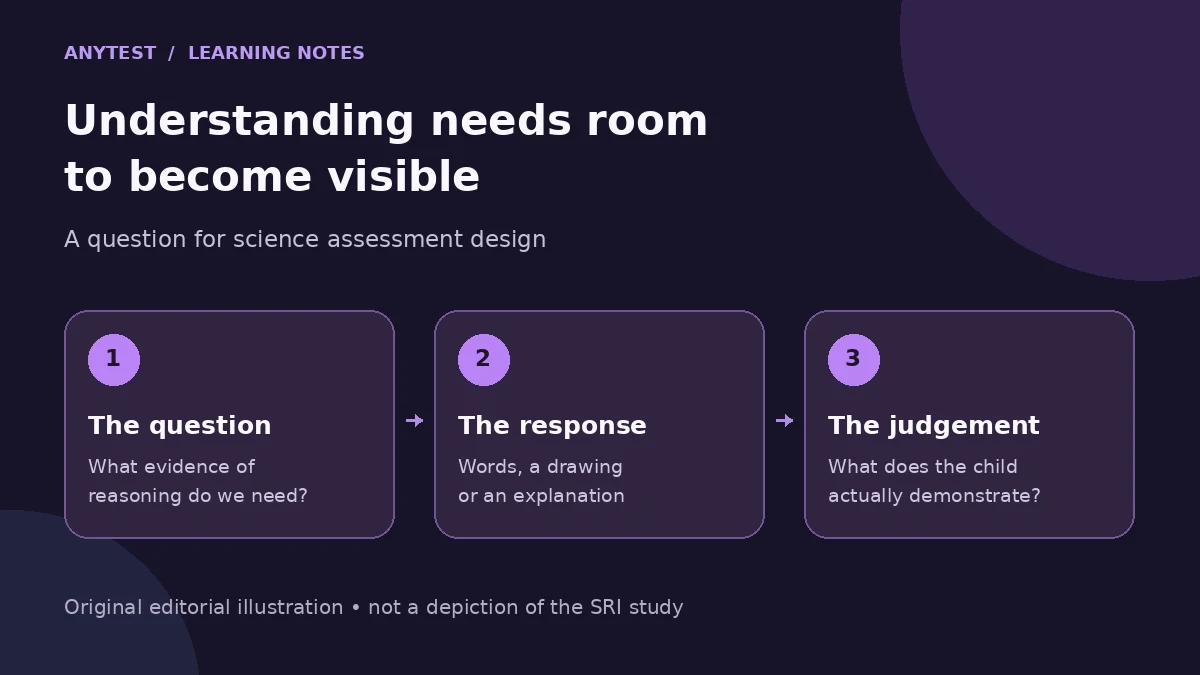
A short written answer can leave a teacher with an awkward question: did the child misunderstand the science, or struggle to express an explanation? In a November 6, 2026 design brief, SRI researchers discuss nine formative science assessment tasks developed with two experienced first-grade teachers. Their focus is making children’s reasoning visible. SRI design brief.
Start with the evidence you want
The authors describe opportunities for children to respond through drawing, speech and gestures, as well as writing. They also discuss clear visual materials and conversation before an individual written response. These are design considerations from classroom work, not proof that one response format always produces better learning. Research team’s account.
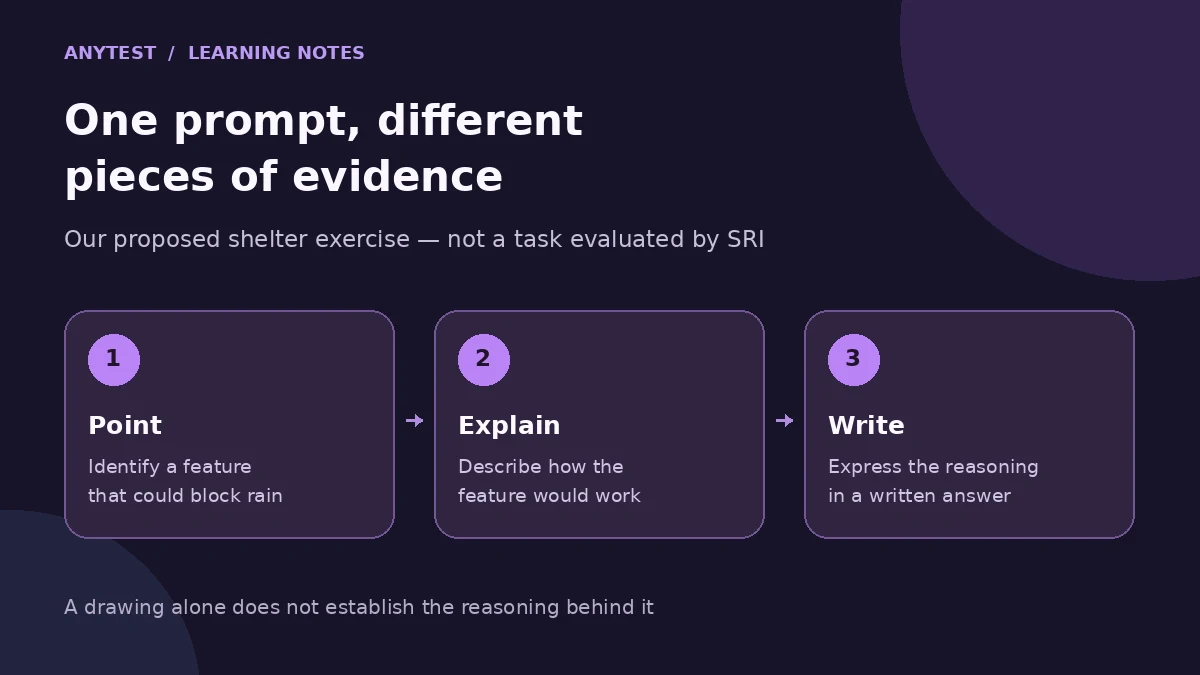
Here is our own example, not a task evaluated in the project. Show two drawings of animal shelters and ask: “Which part could keep rain out? Show me, then explain your choice.” A teacher could record separately whether the child identifies a relevant feature and whether the child can explain its function in writing.
The point of that proposed separation is practical: an unclear sentence would no longer be the only evidence available for judging the explanation. It would still matter what the child actually says or shows. A drawing alone should not automatically receive credit for reasoning that the teacher supplies on the child’s behalf.
What has—and has not—been released
The work belongs to SRI’s SALDEE project on science assessment and language diversity. Its November 5 overview describes tasks, scoring rubrics and administration guides; it says resources will become freely available and invites interested teachers to request access. That is not the same as an already open download library. Project overview.
The overview lists related conference work from June 2026. The November news is the team’s explanation of its design approach, not a newly reported November controlled trial. Publication listing.
For a classroom or quiz author, the useful next step is small: choose one question and write down exactly what counts as evidence of understanding. Then consider whether its response format lets the learner provide that evidence. Treat this as a design exercise to evaluate, not a guaranteed intervention.
Sources
Arif Rachmatullah, Nonye M. Alozie, Hui Yang and Marta Mielicki. Making young students’ scientific thinking visible: Five design features that support life science learning. SRI, November 6, 2026.
SRI. Developing Science Assessments for Language Diversity in Early Elementary Classrooms (SALDEE). November 5, 2026.