A VHF radio is useful only when the person holding the microphone can choose the right priority, reach the right audience and give information that another station can act on. SRC preparation therefore needs more than remembering that channel 16 is important. You need to understand the relationship between digital alerting, voice communication, position information, equipment and the rescue organisation.
This guide covers the knowledge in the CEPT Short Range Certificate syllabus for voluntary, non-SOLAS GMDSS vessels operating in sea area A1, with UK licensing context. It accompanies an independent 125-question SRC theory learning bank. The examples are original teaching scenarios, not official examination questions. Source checks were completed on 28 November 2026. Sources: ERC/REC 31-04 (2024).
What the official SRC assessment involves
The RYA examination includes a written theory paper and a practical assessment using marine VHF equipment. Candidates must be at least 16. The usual route is completion of a recognised SRC course; the RYA also describes eligibility through an existing RYA Restricted VHF certificate or a suitable aviation radio qualification. Check the precise route and documentary requirements with the recognised centre. Course completion alone is not the same as passing the assessment. Sources: RYA SRC examination.
The RYA lists ten hours for the course, with examination time additional. Classroom and online course routes are available, but the examination is conducted through a recognised centre. If studying online, arrange the practical examination location before committing to the course. The current public pages used here do not establish a precise written-paper question count, pass mark or duration, so the learning bank does not pretend that its settings reproduce those details. Confirm current booking requirements, fees, identification and photograph arrangements directly with the centre. Sources: RYA Marine Radio SRC course, RYA SRC examination.
The CEPT syllabus has five broad areas: radio principles and safety information; equipment knowledge; DSC and other safety subsystems; radiotelephony procedures; and regulations. The practical elements require actual performance. Choosing a correct answer cannot demonstrate that you can speak intelligibly, enter a position correctly under pressure, interpret an alarm or operate an unfamiliar training radio. Use this guide to understand the decisions, then rehearse them under appropriate instruction. Sources: ERC/REC 31-04 (2024).
How the radio system fits together
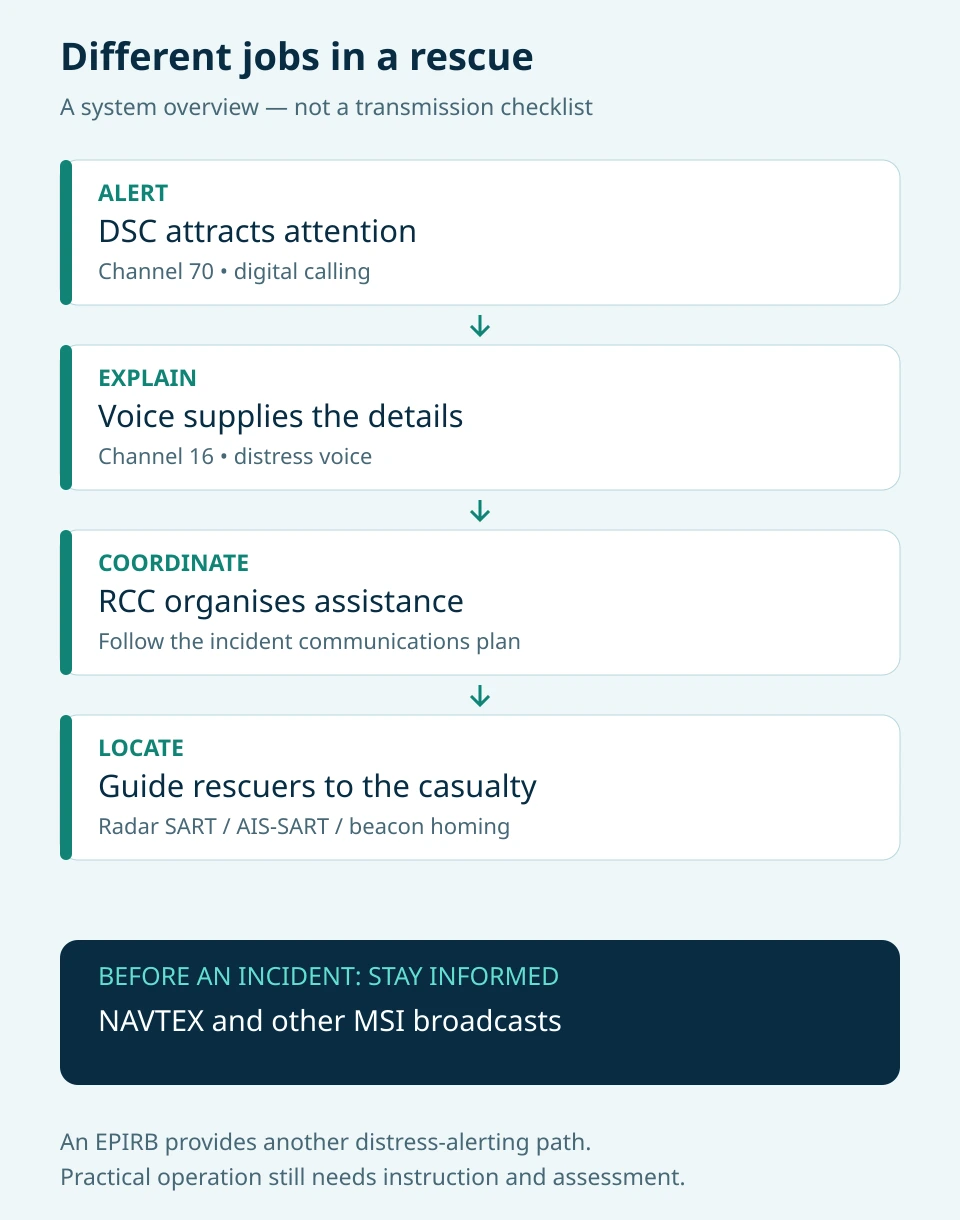
GMDSS is a coordinated distress and safety system using terrestrial and satellite services. A useful way to understand it is to separate four jobs: alert someone that help is needed; communicate enough detail to organise assistance; locate the casualty; and deliver safety information before an emergency develops. VHF DSC and voice, 406 MHz beacons, locating devices and NAVTEX perform different parts of those jobs. One device does not automatically replace all the others. Sources: MCA GMDSS VHF DSC procedures for small-boat users, MCA MSI leaflet January 2026, Ocean Signal EPIRB1 manual issue 01.24, Ocean Signal S100 SART manual v02.01.
A ship station operates aboard a vessel. Coast stations provide shore communications; port, pilot and VTS stations support local operations and movements. On-board communication includes exchanges between a vessel’s bridge and its own mooring party. A rescue coordination centre organises SAR services and coordinates distress traffic or appoints another station to do so. Aircraft can participate in on-scene exchanges. A search and rescue region identifies an area of coordinated SAR responsibility, not a guaranteed radio range. During an incident, follow the communications plan rather than creating several competing exchanges. Sources: ERC/REC 31-04 (2024), ITU Radio Regulations 2024 Volume 1.
Sea area A1 is defined by coverage of one or more VHF coast stations providing continuous DSC alerting, as specified by the administration. It is not simply a twelve-mile strip or a promise that every handheld will reach shore. A2 lies outside A1 but within declared MF coast coverage with continuous DSC alerting. SRC study concentrates on VHF in A1 while recognising that longer voyages require appropriate communications planning. Sources: MCA GMDSS VHF DSC procedures for small-boat users.
VHF range, channels and current channel plans
Frequency is the rate at which a radio signal oscillates. A channel gives the operator a convenient identifier for its assigned frequency or frequency pair. Marine VHF propagation is mainly line of sight: antenna height at both ends, the Earth's curvature and obstructions influence reception. More power can help a weak link, but cannot be treated as a guarantee of communication behind a headland. A low handheld antenna generally has less useful range than a properly installed masthead antenna. Sources: Simrad About VHF radios, RYA onboard communications.
In simplex operation stations take turns transmitting. On the usual marine simplex channel they share the same frequency, so other stations on that channel can follow both sides. A coast-working duplex pair uses separate ship and shore frequencies; a ship set may still require push-to-talk, making the arrangement semi-duplex at that end. Two ordinary ship radios on the same duplex channel may transmit on one frequency while both listen on the other. Selecting the same channel number is therefore not enough to establish a direct ship-to-ship link. Sources: ITU Radio Regulations 2024 Volume 1, Raymarine 81381 rev9: VHF channels.
Channel 16, at 156.8 MHz, supports voice distress, urgency, brief safety communications and initial calling. Channel 70, at 156.525 MHz, carries DSC, including routine calls as well as priority calls; never attempt to speak on it. Channel 13 is primarily for inter-ship navigation safety. In UK waters, MCA identifies 6, 8, 72 and 77 as routine inter-ship working options, subject to local conditions and appropriate use. Port-operation and movement channels carry the operational and safety traffic for which they are assigned. UK channels M and M2 have territorially limited authorisation, not universal international status. Sources: MCA MGN 324 Amendment 2, ITU-R M.541-11 (2023), Ofcom ship and portable licence terms.
Do not treat an old channel list as permanent. MCA MGN 562 explains four-digit designations, correspondence with older equipment and VDES-related restrictions. Before a passage, check current radio publications and the local station's channel/frequency requirements against the set's capabilities. A displayed cross-reference may be needed where the frequency is supported but its label differs. Existing international two-digit simplex channels are unchanged by that renumbering. Updates must follow the manufacturer; the SOLAS radio-survey date in Annex 1 is not a blanket replacement deadline for every pleasure boat. Channels adjacent to 16 also have protective restrictions: Appendix 18 restricts 75/76, except AIS, to navigation-related communications and requires precautions including limiting output to 1 W. Sources: MCA MGN 562 Amendment 4, ITU Radio Regulations 2024 Volume 2.
Worked example: a routine rendezvous. Two yachts make brief initial contact on 16. They agree a suitable clear inter-ship channel, acknowledge the change and move there. Staying on 16 would occupy a priority/calling channel. Moving to 70 would not provide a voice path. A busy VTS channel is not an interchangeable substitute for their rendezvous discussion. If they cannot hear each other on the working channel, they check the selected plan, simplex suitability, volume, squelch and range rather than immediately declaring an emergency. Sources: MCA MGN 324 Amendment 2, Raymarine 81381 rev9: Audio troubleshooting.
NAVTEX and maritime safety information
MSI includes navigational warnings, meteorological warnings and forecasts, and other urgent safety information. International NAVTEX broadcasts text on 518 kHz in English; national services can use other frequencies, including 490 kHz. A receiver selects relevant stations and subject categories, stores or prints the messages and handles repeat transmissions. It is a broadcast receiver, not a device for sending a Mayday or acknowledging a DSC alert. The UK also supplies MSI by scheduled VHF/MF voice broadcasts: use the current MCA timetable and the announced working channel. Sources: IMO NAVTEX Manual 2022 Rev.2, MCA MSI leaflet January 2026.
The four-character NAVTEX technical identity is B1B2B3B4. B1 identifies the transmitter, B2 the subject, and B3B4 the serial number. A is navigational warnings, B meteorological warnings, D includes SAR and specified severe hazard information, and L provides additional navigational warnings. Under the 2022 manual these four subject groups must not be deselected. E is weather forecasts and C is ice reports; choosing optional categories does not remove the mandatory groups. Sources: IMO NAVTEX Manual 2022 Rev.2.
Normal serials run from 01 to 99. Serial 00 is special: its reception overrides station and subject selection and cannot be rejected, including on repeat reception. Do not interpret 00 as a cancellation. Select transmitters for the area you occupy and the areas you will approach, rather than leaving the receiver permanently configured for the home berth. Read the full message and its validity, because the technical serial is not the same thing as the warning number in the text. Sources: IMO NAVTEX Manual 2022 Rev.2, MCA MSI leaflet January 2026.
Worked example: EA42. In this constructed header, E is the transmitter identifier, A means a navigational warning, and 42 is its technical serial. The subject is not a vessel nationality and 42 is not a channel number. If the serial becomes 00, the receiver's special override applies. On passage, the operator still needs the right station selection for ordinary messages and must decide what the warning means for the route. Sources: IMO NAVTEX Manual 2022 Rev.2.
Make the equipment ready before needing it
Know the controls on the actual radio, including its power-on and power-off procedure. A separately powered handset may need its own power control and connection checked even when the base is on. Select the intended channel and verify its displayed identity. Press PTT to speak and release it to receive. Set volume high enough for the environment, then set squelch only high enough to suppress unwanted receiver noise. Excessive squelch can hide weak signals. The display dimmer affects glare, not receiver sensitivity. Use the lowest permitted power that gives satisfactory routine communication; the cited fixed Raymarine set offers 1 W and 25 W. Model details differ, so learn the controls rather than memorising one button sequence for every radio. Sources: Raymarine 81381 rev9: Handset controls, Raymarine 81381 rev9: Audio troubleshooting, Raymarine 81381 rev9: Transmit power, IMO A.954(23) Proper use of VHF channels.
Dual watch normally monitors channel 16 and the selected working channel. Scanning searches a sequence of channels, possibly with a priority check between them. These are useful facilities, but their pauses and configuration matter. They are not proof that every call will be heard. A DSC watch on 70 is distinct from voice monitoring. Keep the relevant watch and meet local VTS or port requirements; an alarm receiver does not give permission to ignore the spoken traffic that follows. Sources: Raymarine 81381 rev9: Watch modes, Raymarine 81381 rev9: Scan mode, MCA GMDSS VHF DSC procedures for small-boat users.
A suitable antenna must be connected before transmitting. Mount it for useful range while respecting the manufacturer's RF exposure clearances, mechanical security and isolation requirements. Keep cabling sound and connections secure. A fixed set needs its specified DC voltage, correct polarity, appropriate conductor size and overcurrent protection. For the cited 12 V set, the positive feed has the prescribed inline fuse. Do not bypass a fuse that repeatedly opens: investigate the cause. A radio that receives but resets during transmission may have a weak supply or excessive voltage drop under load. Sources: Raymarine 81381 rev9: Antenna and EME, Raymarine 81381 rev9: Power connection, Raymarine 81381 rev9: Power troubleshooting.
Inspect cables and connectors with the supply isolated as instructed. Check battery state, clean secure connections and the maker's charging arrangements. A handheld or survival-craft set needs its own dependable reserve if the main supply is lost. Some equipment has separate everyday rechargeable and sealed primary emergency packs. The Ocean Signal V100, for example, offers an RB5V rechargeable pack and a primary emergency pack; its limited-life test pack is not intended for operational use. A primary battery must not be treated as rechargeable. Keep emergency reserves and replacement dates ready for the intended role. Sources: Raymarine 81381 rev9: Routine checks, Raymarine 81381 rev9: Power troubleshooting, Ocean Signal safeSEA V100.
DSC identities and position information
An MMSI is the numerical radio identity used for addressing and identifying calls. Under the current ITU recommendation, an ordinary ship identity has nine digits in the form MIDXXXXXX. The three MID digits identify the administration with jurisdiction over the station. A coast identity follows 00MIDXXXX; a group ship identity follows 0MIDXXXXX. The group format allows several assigned member ships to be called without replacing each one's individual identity. These patterns are not a reason to invent or borrow an MMSI: allocation and programming must follow the applicable authority and equipment process. Sources: ITU-R M.585-10 (2026).
Distinguish the category from the addressee. Distress, urgency, safety and routine are priorities. Individual, group and all-ships describe whom a call addresses. A routine individual call to a known yacht is not an all-ships urgency announcement. Select the intended function and review what the screen says before transmitting. Use the received-call log to retrieve details such as identity, time, call type and any transmitted position; acknowledge an alarm only after understanding what action the call requires. Sources: ITU-R M.541-11 (2023), Raymarine 81381 rev9: Call logs.
DSC distress information should include the position and the UTC time for which it was valid. A correctly configured GNSS source can supply those automatically. If no position source is available, enter latitude, longitude and validity time manually when possible. Seeing a fix on a separate plotter does not prove that the radio is receiving it. Check the radio's display and interface. Stale coordinates combined with a misleadingly current time are worse than a clearly understood limitation, because they can send rescuers towards the wrong place. Sources: ITU-R M.541-11 (2023), Raymarine 81381 rev9: GNSS setup.
Worked example: the disconnected data cable. The plotter shows the yacht's present location, while the VHF still shows the previous day's berth. The operator checks the radio's GNSS source and connection, enters the known current coordinates and UTC validity time if necessary, then verifies the display. Changing the MMSI would not repair the position link. Turning up the transmitter would not update the data. This is a preparation fault to resolve before departure, not a detail to leave until an alarm sounds. Sources: Raymarine 81381 rev9: GNSS setup, ITU-R M.541-11 (2023).
Choose distress, urgency or safety from the facts
Distress is grave and imminent danger requiring immediate assistance. A sinking vessel with people needing rescue meets that threshold. Urgency concerns an urgent safety matter involving a vessel or person without the stated distress threshold. Safety traffic warns about matters such as dangerous navigation conditions or weather. An engine failure is not assigned a category by its name alone: a stable yacht well clear of hazards differs from one being driven onto rocks. Assess the danger and upgrade the response if circumstances worsen. Sources: MCA GMDSS VHF DSC procedures for small-boat users, ITU Radio Regulations 2024 Volume 1.
For distress, use the radio's distress procedure; if time allows, enter the nature of the emergency and verify position/time before sending. Then prepare voice traffic on 16. MCA's small-boat procedure says to make the voice call after acknowledgement or after about fifteen seconds. Do not wait indefinitely for a digital reply. Start with MAYDAY three times, identify the vessel clearly, and provide its call sign and MMSI as applicable. The message then supplies position, nature of distress, assistance required, people aboard and useful rescue information. Release PTT to hear the response. Sources: MCA GMDSS VHF DSC procedures for small-boat users, ITU-R M.541-11 (2023).
Worked example: taking water. In a training scenario, yacht Alder is flooding, pumps are not controlling the ingress and four people are aboard. The operator selects flooding if time permits, sends the DSC alert and follows with the voice distress call. In the message, the known training position comes before the explanation of the flooding; the operator asks for immediate assistance and reports four people. The remaining information might concern lifejackets, the liferaft or another factor that helps rescuers. A detailed account of the earlier passage, the radio model and billing details would delay essential information. Use invented training identities and non-transmitting equipment for rehearsal. Sources: MCA GMDSS VHF DSC procedures for small-boat users, ITU-R M.541-11 (2023).
An all-ships urgency announcement can direct listeners to the intended voice channel. In the MCA small-boat sequence, the voice call on 16 uses PAN PAN three times, addresses all stations, identifies the vessel and gives the nominated working channel before the detailed message there. For an urgent medical concern, describe the actual condition and follow the coastguard's requests; medical need can escalate to distress. Safety voice announcements use SECURITE. The MCA guide describes contacting the coastguard with safety information by individual DSC safety call where supported, or by voice if that function is unavailable. These are different procedures from broadcasting your own false Mayday just to attract attention. Sources: MCA GMDSS VHF DSC procedures for small-boat users, ITU-R M.541-11 (2023).
Receiving an alert, relaying and controlling traffic
A received DSC distress alarm is a request to listen and act appropriately, not an instruction for every ship to send an immediate digital acknowledgement. Normally the coast station or RCC acknowledges DSC distress. Listen on 16 and allow shore to respond. Under MCA guidance, if no acknowledgement has been heard after five minutes and you can assist, acknowledge by voice, offer the assistance you can provide and relay details to the appropriate station. The exceptional transmission of a ship's DSC acknowledgement to stop a repeating alert requires consultation with, and direction from, a coast station or RCC. Sources: MCA GMDSS VHF DSC procedures for small-boat users, ITU-R M.541-11 (2023).
Never send an all-ships DSC distress relay simply because you received another ship's VHF DSC distress alert. ITU M.541 expressly prohibits that action. This is different from discovering another vessel in distress that cannot alert anyone: a relay may then be needed. With Class D equipment lacking a DSC relay function, use the appropriate voice Mayday Relay to the coast station or RCC and give the known facts. A coast-originated DSC distress relay is acknowledged by voice on the associated distress traffic channel, not by a mass of ship DSC acknowledgements. Sources: ITU-R M.541-11 (2023).
A voice acknowledgement uses RECEIVED MAYDAY with the necessary identification. Subsequent exchanges remain distress traffic; give the assistance available, your position or ETA when relevant, and follow the controller's instructions. The responsible RCC coordinates or appoints control. SEELONCE MAYDAY orders interfering stations to be silent. Stations not involved and not themselves in distress must stay off the frequencies carrying the distress traffic until normal working is permitted. SEELONCE FEENEE is part of the controlling station's formal end message. A quiet interval does not authorise an ordinary listener to declare the rescue over. Sources: MCA GMDSS VHF DSC procedures for small-boat users, ITU Radio Regulations 2024 Volume 1.
Worked example: a repeated alarm. A yacht receives the same DSC alert repeatedly. The operator listens on 16 and gathers the available details. Turning the alarm volume down is not a complete response, and sending an all-ships digital relay would breach the VHF relay rule. If the yacht can assist and the no-acknowledgement conditions are met, it uses the voice response and contacts the coastguard. Only a specific shore/RCC direction justifies the exceptional ship DSC acknowledgement. Sources: MCA GMDSS VHF DSC procedures for small-boat users, ITU-R M.541-11 (2023).
False alerts and sensible equipment tests
Prevent false alerts through protected controls, crew briefing and correctly arranged training. A distress-button test itself must not radiate. Where the set and receiving service support it, use the DSC test-call function addressed to the appropriate MMSI and await its acknowledgement. A spoken radio check belongs on an appropriate clear channel, with identification and a brief request. Neither routine checks nor classroom rehearsal justify obstructing a live distress or port-operation channel. Sources: ITU-R M.541-11 (2023), IMO A.954(23) Proper use of VHF channels.
If an inadvertent DSC distress alert has already gone out, stop the alert and use the supported DSC self-cancellation function if available. Also send the voice cancellation on the associated distress frequency, channel 16 for VHF. Identify the vessel, call sign and MMSI, and clearly cancel the alert of the stated UTC time. Continue monitoring and answer queries. Deleting the local log or switching off does not erase what others received. Distinguish this from SEELONCE FEENEE, which closes controlled distress traffic rather than identifying your particular accidental transmission. Sources: ITU-R M.541-11 (2023), ITU Radio Regulations 2024 Volume 1.
EPIRBs, SARTs and the handheld in a liferaft
A 406 MHz EPIRB sends a satellite distress alert; its 121.5 MHz signal supports local homing. The beacon's identity and current registration help authorities connect the alert to the right vessel, people and contacts. MCA's March 2026 guidance requires registration of carried EPIRBs and 406 MHz PLBs on UK-registered ships; it does not itself create a universal carriage requirement for every craft. The radio licence, an SRC and beacon registration are separate matters. Keep changes promptly updated through the UK Beacon Registry. Sources: Ocean Signal EPIRB1 manual issue 01.24, MCA MGN 665 Amendment 1 (2026).
Know how the particular beacon activates. A float-free EPIRB installation uses a correctly mounted housing and hydrostatic release so the beacon can escape a sinking vessel and operate as designed. Keep its path clear and observe release-unit as well as battery replacement dates. Manual-release beacons require different handling. When deployed, follow the instructions for orientation and clear sky view; a tether must not drag the beacon down with the sinking vessel. Use the specified self-test, not a real emergency activation as an experiment. After accidental activation, deactivate it and promptly tell the rescue authority its identity, location and activation time. Sources: Ocean Signal EPIRB1 Pro manual issue 02.34, Ocean Signal EPIRB1 manual issue 01.24.
A conventional radar SART is a locating responder: a nearby X-band radar interrogates it and sees a characteristic series of returns, commonly twelve dots at suitable range, becoming arcs or rings at closer range. Position it upright and high on the survival craft as instructed. Its operating range depends on the installation and geometry; it is not a substitute for the primary distress alert. An AIS-SART instead transmits AIS locating information. Check the exact equipment type rather than assuming all devices called SART work through radar. Replace the SART battery by the marked expiry and follow its post-use service requirements; a brief successful test does not renew its emergency reserve. Keep tests brief and follow the manual, because test responses can be visible to nearby rescuers and consume battery reserve. Sources: Ocean Signal S100 SART manual v02.01, ITU-R M.585-10 (2026).
The handheld provides two-way communication when the fixed installation is unavailable or after abandonment. Its antenna height and power limit range, so use a safe position that gives the best practical radio path. Check the available channels, waterproofing arrangements, battery type and expiry; do not assume every handheld has DSC or GNSS. Preserve a serviceable emergency pack where the model uses one, and keep a suitable everyday rechargeable pack ready through its approved charger. Familiarity with this small set is a separate practical skill from recognising its picture. Sources: RYA onboard communications, Ocean Signal safeSEA V100.
Clear speech, routine calling and public correspondence
Use standard wording to reduce ambiguity. OVER invites a reply; OUT ends the communication. SAY AGAIN requests repetition, and CORRECTION introduces corrected information. If a caller's identity is unclear, ask the station calling your vessel to identify itself. Never claim to have understood a garbled safety instruction. IMO Standard Marine Communication Phrases provide a common safety vocabulary; the international phonetic alphabet helps spell names and call signs. For example, BEX becomes Bravo Echo X-ray, while KILO becomes Kilo India Lima Oscar. Sources: Raymarine 81381 rev9: Prowords, IMO A.918(22) Standard Marine Communication Phrases.
Listen before calling, identify the station and yourself, keep the exchange brief and use a working channel appropriate to the purpose. If changing channels, agree and acknowledge the change. If unanswered, wait a suitable interval rather than repeatedly occupying the frequency. The coast station controls the working channel for its exchanges. When receiving an individual routine DSC call from shore, acknowledge appropriately if able to comply and prepare on the agreed voice channel. A routine ship-to-ship DSC call proposes a suitable inter-ship channel; in the normal ship-to-coast procedure the coast station supplies the working channel in its acknowledgement. An unable-to-comply reply is not a completed connection. Sources: IMO A.954(23) Proper use of VHF channels, ITU-R M.541-11 (2023), MCA GMDSS VHF DSC procedures for small-boat users.
Public correspondence connects a vessel with a public telecommunications service. Availability varies, and charges/accounting arrangements must be checked with the service. An AAIC identifies an accounting authority, an intermediary handling maritime communication accounts; it is neither an MMSI nor an operator certificate. ITU MARS and List V contain notified accounting/identity information. Do not assume possession of an SRC makes shore telephone calls free, or use a higher safety priority to obtain an ordinary paid service. Sources: ITU MARS FAQ (21 November 2025), ITU Radio Regulations 2024 Volume 1.
UK licences, records and documents
The operator certificate demonstrates competence; the ship radio licence authorises the station and equipment under its terms. Ofcom permits normal use by authorised persons with the relevant certificate and authority, or under the direct personal supervision of such a person. Its terms also permit anyone to use the equipment to summon assistance in an emergency involving risk to life. The exception is there for the emergency; it does not turn independent online study into normal operating qualification. Sources: Ofcom ship and portable licence terms.
The licence is not transferable on a sale. The new owner must arrange correct licensing, even where the vessel retains its assigned identity. Notify changes in licence details; if details remain unchanged, Ofcom requires confirmation at least once every ten years. Keep the relevant documents with or near the equipment where practicable and take them abroad as required. A UK Ship Portable Radio Licence has the stated UK, Channel Islands and Isle of Man territorial-sea limits: carrying a portable set between vessels does not create worldwide authorisation. Sources: Ofcom ship and portable licence terms, Ofcom ship radio and ship portable radio.
Know where information belongs. ITU List IV covers coast and special-service stations; List V covers ship stations and identity assignments; MARS provides notified data online. Current national publications and radio-signal references help with channels and services along the passage. Record distress calls and significant exchanges accurately and inform the master; do not assume the radio's electronic history is the whole incident record. Preserve the secrecy of private correspondence not intended for general reception: easy reception is not permission to disclose it. Required rescue communication is different from publishing private traffic. Sources: ERC/REC 31-04 (2024), ITU MARS FAQ (21 November 2025), IMO A.954(23) Proper use of VHF channels, ITU Radio Regulations 2024 Volume 1.
A preparation sequence you can actually use
First, draw the system from memory: ship radio, coast/RCC, assisting units, beacon alerting, locating equipment and safety broadcasts. Label the difference between channel 70 digital calling and channel 16 voice. Second, classify short scenarios as distress, urgency, safety or routine and explain the facts that determine the choice. Third, rehearse a clear voice message with an instructor or safe non-transmitting arrangement, including listening and responding rather than merely reciting an opening. These are suggested study activities, not additional official examination rules.
Next, use the actual training set to find the controls, position display, logs and call types. Work through a stale-position problem, an unanswered routine call, a received distress alert and an accidental-alert cancellation. Review NAVTEX filtering and message headers, then inspect the different roles of EPIRB, radar SART, AIS-SART and handheld. Finally, check the licensing and document distinctions. These activities follow the syllabus areas but practical competence still needs appropriate assessment. Sources: ERC/REC 31-04 (2024).
Use the linked test without trying to manufacture a pass certificate from its score. For each mistake, write the condition you overlooked: shore versus ship acknowledgement, received alert versus witnessed casualty, primary versus rechargeable battery, or identity versus licence. Revisit that source and try the reasoning again. The bank presents all 125 questions in shuffled order, with one correct option each, no timer and no pass threshold. It is intended to reveal gaps before the official assessment.
Start with the SRC theory learning bank, then use the RYA examination page for the assessment route, CEPT for the scope, MCA for UK procedures, Ofcom for licence terms and the manufacturer's current manual for the particular equipment. None of those documents replaces careful practical tuition, and this guide does not reproduce a confidential official question pool. Sources: RYA SRC examination, ERC/REC 31-04 (2024), MCA GMDSS VHF DSC procedures for small-boat users, Ofcom ship and portable licence terms.
Source editions and access
Checked 28 November 2026. CEPT, RYA public information, MCA, Ofcom, ITU and IMO documents linked here are public reference material. The RYA course handbook and confidential assessment paper are not reproduced. Manufacturer manuals explain particular models; their specifications are not universal radio limits. The following list records the editions and sections used.
- ERC/REC 31-04 (2024) — Annexes 1–2.
- RYA SRC examination — Exam format and eligibility.
- RYA Marine Radio SRC course — Course details.
- MCA GMDSS VHF DSC procedures for small-boat users — Best practice; distress, urgency, safety, routine; sea areas.
- ITU-R M.541-11 (2023) — Annex 3 §§1–5; Annex 1.
- ITU-R M.585-10 (2026) — Annex 1 §§1–2; Annex 2 locating identities.
- IMO NAVTEX Manual 2022 Rev.2 — §§5.1–5.4, 8.1.
- MCA MSI leaflet January 2026 — §§1,5–9.
- MCA MGN 324 Amendment 2 — §§2–3.
- MCA MGN 562 Amendment 4 — §2; Annex 2.
- ITU Radio Regulations 2024 Volume 1 — Arts 1,17,32,33,51.
- ITU Radio Regulations 2024 Volume 2 — Appendix 18, note n.
- IMO A.954(23) Proper use of VHF channels — Annex §§1–2.
- IMO A.918(22) Standard Marine Communication Phrases — General §§2,5–6,11; Part A1.
- Ocean Signal EPIRB1 manual issue 01.24 — §§3–5.
- Ocean Signal EPIRB1 Pro manual issue 02.34 — §§3–4,8.
- Ocean Signal S100 SART manual v02.01 — §§4–6.
- Ocean Signal safeSEA V100 — Battery provision, specifications and FAQs.
- MCA MGN 665 Amendment 1 (2026) — §§1–6.
- ITU MARS FAQ (21 November 2025) — Ship/coast databases and AAIC questions.
- Raymarine 81381 rev9: VHF channels — International channels and duplex explanation.
- Raymarine 81381 rev9: Watch modes — Dual and triple watch.
- Raymarine 81381 rev9: Scan mode — Channel search and priority scan.
- Raymarine 81381 rev9: Handset controls — PTT, channels, volume/squelch, power.
- Raymarine 81381 rev9: Audio troubleshooting — Volume and squelch.
- Raymarine 81381 rev9: Transmit power — High/low setting.
- Raymarine 81381 rev9: GNSS setup — Automatic and manual position/time.
- Raymarine 81381 rev9: Call logs — Recorded call details.
- Raymarine 81381 rev9: Antenna and EME — Connection and safe siting.
- Raymarine 81381 rev9: Power connection — Supply, polarity and fuse.
- Raymarine 81381 rev9: Power troubleshooting — Under-load voltage and connections.
- Raymarine 81381 rev9: Routine checks — Cables/connectors; power isolated.
- Raymarine 81381 rev9: Prowords — OVER, OUT, SAY AGAIN, STATION CALLING.
- Simrad About VHF radios — Range: line of sight and antenna heights.
- RYA onboard communications — VHF; antenna; DSC.
- Ofcom ship and portable licence terms — Clauses 5–7,10–12; Schedule 1 §§1–9; Schedule 2 §§1–5.
- Ofcom ship radio and ship portable radio — Licensing FAQs; changes of ownership.