What this qualification covers
GMDSS is the Global Maritime Distress and Safety System. Its purpose is to make an emergency known, connect the people who can help, support communication during a rescue and deliver information that can prevent the next emergency. A satellite terminal is one component of that system. So are terrestrial radio, survival equipment, warning receivers, the watchkeeper and the rescue coordination centre. A useful study habit is to identify the function first, then the equipment and procedure that perform it. 80.5 and 80.1081.
This guide prepares English-speaking learners for the knowledge covered by the United States FCC GMDSS Radio Operator’s License, commonly identified as DO, through written Elements 1 and 7. Part 13.201 also recognizes the specified US Coast Guard or designee proof-of-passing route from an approved GMDSS course. The Restricted GMDSS license uses Element 7R instead; the GMDSS maintainer route uses Elements 1, 3 and 9. Passing one of these combinations does not silently confer the privileges of another. 13.201.
Element 1 establishes basic maritime radio law and operating practice. Element 7 extends that foundation to GMDSS subsystems, procedures, documents, English communication, radiotelephony, narrow-band direct printing and the required safety functions. Reading and multiple-choice work cannot demonstrate spoken clarity, hands-on console operation, safe installation work or competence in an actual emergency. This article and its learning bank are not an STCW endorsement, a practical course or authorization to transmit. 13.203(a)(1) and (4).
The detailed topic map uses the FCC Element 1 pool approved in June 2009 and the Element 7 pool adopted in October 2021; the latter’s internal heading says 2019. The 2021 FCC adoption notice establishes that edition and its transition, not a guarantee that an archived file is the latest file on a future examination date. We checked the current regulatory scope and current examiner descriptions on November 28, 2026. The live FCC pool endpoint was inaccessible during verification. Confirm the examiner’s current pool before booking; this original bank deliberately does not claim to reproduce the current official question set. DA 21-1250, October 6, 2021.
US Captains Training currently describes Element 1 as 24 questions with 18 correct needed to pass. Its process includes an FCC Registration Number, booking, identity verification and examination/application steps. These are useful booking instructions from that examiner, rather than a promise that every examiner uses the same scheduling arrangement. Element 1 format and booking.
The same examiner describes Element 7 as 100 questions with 75 correct needed to pass. Its own course requires a higher practice score before unlocking the final examination; that internal course requirement is not the official examination pass mark. Ask your chosen examiner about duration, permitted aids, identification and remote-room arrangements. We have not established one universal current time limit or allowed-materials policy from the sources used here. Element 7 format and course process.
A — Functions, coverage and carriage
The required functions connect both directions: ship-to-shore and shore-to-ship distress alerting, ship-to-ship distress alerting, SAR coordination, on-scene communication, locating signals, MSI, general communications and bridge-to-bridge communication. The requirement for independent ship-to-shore alerting means examining the complete paths and services. Two buttons feeding one transmitter and one antenna are not two independent means merely because they are physically separate. 80.1081.
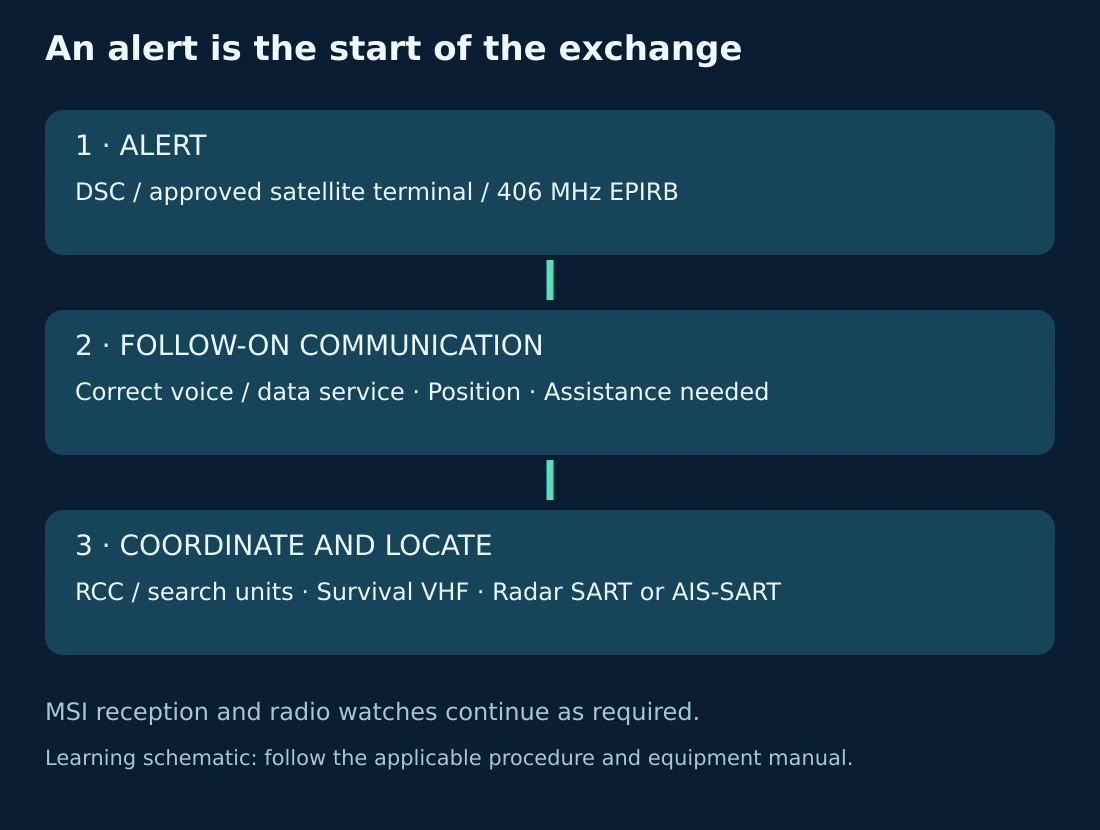
Original teaching diagram. An alert, the subsequent communication and the locating equipment have related but different jobs; actual actions depend on the applicable procedure and installation.
A sea area is a coverage definition, not a fixed distance painted around every coastline. In the cited US text, A1 concerns VHF coast radiotelephone coverage with continuous DSC alerting. A2 excludes A1 and concerns the corresponding MF service. The retrieved US definition of A3 still refers to Inmarsat geostationary coverage with continuous alerting outside A1 and A2; A4 is outside those three areas. A near-shore location is not automatically A1 if the specified coast service is absent. 80.1069, text through November 25, 2026.
International SOLAS modernization changed the A3 definition to refer to the recognized mobile satellite service supported by the ship earth station carried, and revised the equipment framework. Those amendments took effect in 2024. Do not silently substitute that wording into a question expressly asking about the retrieved US CFR text, or assume that a legacy US provision describes every flag-state installation. State the jurisdiction and edition before answering a carriage question. SOLAS Chapter IV amendments and commencement.
For a voyage, map the required functions to equipment suitable for the actual coverage: VHF DSC and voice, the applicable MF/HF or satellite arrangement, MSI reception, EPIRB and survival locating/voice equipment. Distress controls must be accessible from the specified navigating position. Leaving NAVTEX coverage does not remove the need for MSI; the applicable satellite or HF alternative must cover the route. The detailed carriage provisions contain alternatives and conditions, so a generic shopping list is insufficient. 80.1085–80.1095.
Under the cited US survival-equipment rule, passenger ships and cargo ships of 500 gross tons or more have at least three two-way VHF radiotelephone apparatus. Cargo ships from 300 to less than 500 gross tons have at least two. The standard locating-device arrangement is one on each side for the first group and at least one for the smaller cargo group, with specified alternative survival-craft stowage. A qualifying radar SART or AIS-SART can fulfill the locating-device role; calling every such device a radar transponder hides that alternative. 80.1095.
Availability includes maintenance arrangements. A1/A2 operation permits one or a combination of accepted methods; A3/A4 requires at least two among duplication, shore-based maintenance and at-sea electronic maintenance capability. Choosing duplication plus shore maintenance does not by itself create an additional universal at-sea-maintainer requirement. Choosing at-sea maintenance does require qualified personnel and appropriate manuals, tools, test equipment and spares. A contract is not a repair: the ship must be capable of the required distress-and-safety functions before departure. 80.1074 and 80.1105.
B — Frequencies, emissions and antennas
Frequency tells you where a signal lies in the spectrum. MF spans 300 kHz to 3 MHz, HF 3–30 MHz, VHF 30–300 MHz, UHF 300–3000 MHz and SHF 3–30 GHz. Convert units before classifying: 2182 kHz is 2.182 MHz, so it is MF; 156.8 MHz is VHF; 406 MHz is UHF. A missing unit can create a thousandfold error even when the digits look familiar. topics 7–8.
Modulation puts information onto a radio signal. FM varies instantaneous carrier frequency. Conventional AM voice uses a carrier and two sidebands; single-sideband voice conserves spectrum and avoids transmitting an unnecessary sideband. J3E denotes single-sideband telephony with suppressed carrier; H3E retains a full carrier; F3E is FM voice. F1B/J2B belongs to the radiotelex/data context. Selecting a correct frequency with the wrong emission does not establish a usable connection. topics 9–10 and 80–84.
Bandwidth is the portion of spectrum occupied by an emission; channel spacing keeps neighboring assignments sufficiently apart. Conventional NBDP uses narrower spacing than HF SSB voice, and marine VHF FM voice is wider again. For the syllabus comparison, 3.0 kHz voice spacing divided by 0.5 kHz NBDP spacing is six. This ratio is neither a transmitter-power ratio nor a promise that six arbitrary transmissions can be fitted into an occupied channel. topics 11 and 83–84.
An antenna coupler adjusts the electrical impedance match; it does not physically lengthen a whip. The RF ground or counterpoise belongs to the antenna system, and the condition of connections matters. “Omnidirectional” usually describes horizontal coverage rather than equal radiation in every direction. Superstructure, height and the elevation pattern still affect performance. Use the approved installation rather than improvising a universal wire length or bypassing a failed coupler without the relevant equipment procedure. topics 12 and 100.
C — The operator’s routine: documents, power, tests and logs
Operator qualification and maintenance qualification are different. A person qualified to operate the console is not automatically authorized to make internal adjustments that can affect proper operation. The US rules specify primary and backup GMDSS operator responsibility and the conditions for an at-sea maintainer. The required operator document or permitted copy must be posted or available as specified. Keep the current station documentation and actual equipment manuals accessible rather than relying on memory from a different model. 13.19 and 13.201; see also Part 80.1073–80.1074. 80.1073–80.1074.
Mandatory inspection is not simply a visit requested from an FCC district office, as an old study answer may suggest. The current rule normally uses an independent FCC-licensed GMDSS maintainer technician meeting the stated independence conditions. Exemptions are also conditional decisions by the appropriate authority, not a master’s unilateral declaration that one exceptional voyage needs no radio equipment. Check the exact provision rather than treating an old pool key as present law. 80.59 and 80.1071.
The reserve source supports the required radio installation when normal and emergency ship supplies fail; independence is the point. The required duration depends on the ship and the rule’s conditions, so “every ship needs one hour” is unsafe shorthand. Recharge capability must restore the required minimum capacity within ten hours. Check the reserve source with equipment on and the charger off at intervals no longer than 30 days, and preserve the necessary navigation-input supply arrangements. 80.1099.
For arithmetic practice, a constant 9 A load for two hours consumes 18 Ah before losses and margins. That calculation teaches current multiplied by time; it is not a compliant battery selection. Real assessment must include the required equipment combination, transmit/receive duty, actual battery condition, temperature and applicable duration. For lead-acid batteries, a hydrometer measures electrolyte specific gravity where the battery type permits that procedure. Temperature correction matters. Do not open a sealed gel battery or apply an unsuitable equalization profile. topics 17 and 99; Part 80.1099 for the installation requirement. 80.1099.
Daily checks, weekly operational/test checks and the reserve-source interval are different tasks. The current US log rule includes daily satisfactory checks, weekly DSC communication or test and specified survival-equipment checks, and the at-least-30-day reserve check. Each watch includes checking the navigation interface and ensuring position is available. If automatic input is unavailable while underway, the operator must manually update position at least every four hours. An equipment-specific self-test is not permission to radiate a real distress alert. 80.409(e), 80.1073 and 80.1105(k).
Record meaningful events: distress and relevant urgency traffic, false alerts and their cancellation, malfunctions and restoration, inspections, required tests and relevant equipment replacement including correct MMSI handling. Correct an entry without hiding the original: the rule provides for a legible strike-through, identification of the correction and its date, including the corresponding electronic-record method. The licensee and operator in charge have responsibilities; an inspection does not transfer all later logging responsibility to the inspector. 80.409.
Retention has several conditions. The ordinary retention period is two years from entry; distress entries are retained three years. Records involved in an investigation must remain until specific written authorization permits destruction, and claims can require longer retention. The aboard-retention provision includes a 30-day original-entry minimum and a further two-year-from-last-inspection requirement for the specified logs. “Keep every GMDSS log only 30 days” is therefore not an adequate reading of the current rule. 80.409(a)–(b).
D — Identities and DSC setup
A voice call sign, a radiotelex SELCAL, an MMSI and a satellite mobile number are different identifiers. An ordinary ship MMSI has nine digits: a three-digit MID followed by six further digits. A group ship identity begins with 0 before its MID; a coast identity begins with 00 before its MID. The MID identifies the assigning administration, not the vessel’s current position. For example, 0-MID-12345 has the group-ship structure, whereas 00-MID-1234 has the coast structure. Annex 1, sections 1–2.
The distinction extends to locating devices. The 970 prefix identifies AIS-SART, 972 identifies the relevant man-overboard device format and 974 identifies EPIRB-AIS. These special device identities are not ordinary ship MMSIs; the current ITU recommendation explicitly distinguishes them. It is wrong to read 970 as the nationality MID of a ship. Manufacturer and sequence fields follow the special prefix, with additional identity provisions in the current standard. Annex 2, section 2.
Older service numbering remains in the adopted FCC material. Inmarsat-C mobile numbers begin with 4 in the examined scheme; historical Fleet 77 numbers begin with 76. Neither rule turns those numbers into the ship’s DSC MMSI. Legacy radiotelex selective calling can use other numerical identity lengths. Always ask which system and address field a question is discussing before counting digits. topics 21–25.
DSC is an alerting and calling mechanism. A call contains a category, identity/address information and the details needed for the subsequent exchange. An individual routine call to another ship uses that ship’s MMSI, routine category and a suitable proposed working channel. Commercial importance is not a reason to select urgency. A distress alert should include the latest known position and the UTC time for which it is valid, with the nature of distress and subsequent communication information when time permits. Annex 3, A3-1.1 and A3-4.2.
Learn frequency pairs by function. VHF DSC uses channel 70, 156.525 MHz, while associated distress voice uses channel 16, 156.8 MHz. MF DSC is 2187.5 kHz and associated voice is 2182 kHz. In the 8 MHz band, DSC is 8414.5 kHz, voice is 8291 kHz and NBDP is 8376.5 kHz. HF MSI at 8416.5 kHz is a separate allocation. Similar numbers do not imply interchangeable use. 80.1077.
For the US MF/HF DSC watch, 2187.5 and 8414.5 kHz are accompanied by at least one appropriate additional listed HF DSC frequency: 4207.5, 6312, 12577 or 16804.5 kHz. Selection depends on time and position. Maintain the applicable satellite and MSI watches too. The cited GMDSS provision also retains a manned channel 16 listening watch when practicable; automatic digital watch does not make voice traffic irrelevant. 80.1123.
E — Distress, urgency, safety and cancellation
Distress means grave and imminent danger requiring immediate assistance. MAYDAY introduces the distress call. Give a clear identity, position, nature of distress, assistance needed and useful rescue details such as persons on board and vessel description. PAN PAN identifies urgency concerning safety that does not meet the distress condition; SECURITE introduces safety information such as a navigational warning. The order is distress, urgency, safety, then other communications. 80.91, 80.314 and 80.330–80.332.
Consider an original study scenario: a vessel is sinking and the master orders a VHF distress alert. The digital alert belongs on channel 70, while follow-on voice belongs on channel 16. Preparing the voice information is therefore part of the response, not a reason to speak into channel 70. Read the equipment’s delivery and acknowledgement indications, and keep the required reception active. A light on a distress button is not proof that a rescue centre has acknowledged. Annex 3, A3-1.1–A3-1.3.
A receiving ship normally does not acknowledge another ship’s DSC distress alert by DSC: the coast station or RCC normally performs that action. In MF/VHF coast coverage, allow the coast station the first opportunity, monitor for acknowledgement and listen to the associated voice distress channel. If repeated MF/VHF alerts continue, a ship’s DSC acknowledgement to stop them requires consultation with a coast station or RCC and direction to do so. Silencing an audible alarm on the bridge is a different act from sending a radio acknowledgement. Annex 3, A3-1.2.
Relaying requires attention to context. Do not automatically send an all-ships DSC relay after receiving another ship’s MF/VHF DSC alert; the recommendation prohibits that cascade-producing response. A casualty unable to send its own alert may need a relay on its behalf, preferably directed to the appropriate coast station or RCC. For a received HF DSC alert, Annex 3 gives the ship procedure: if no coast-station DSC acknowledgement arrives within five minutes and no distress communication is observed between a coast station and the casualty, inform an RCC through appropriate radiocommunications means. Transmit a DSC distress relay if instructed by the RCC or a coast station. Annex 1 states the general five-minute relay rule, but it must not be taught without those operational conditions. A relay is manually initiated and preferably directed to an individual coast station or RCC; neither automatic relaying nor an extra waiting period is the prescribed response. Annex 3, A3-1.4 and A3-6.1.4–A3-6.1.5; compare Annex 1, A1-3.4.2.
For an all-ships urgency or safety announcement, recipients do not each send a DSC acknowledgement. They listen on the announced follow-on channel. Safety messages should preferably move to a working frequency in the same band. In a routine exchange, listen before transmitting and shift from the calling channel to a suitable working channel once contact is established. Use standardized spelling words where clarity requires them: for example, Echo, Mike and Sierra for E, M and S. Annex 3, A3-2–A3-4; FCC Element 1 topic 9 for spelling. topic 9, international spelling alphabet. 80.92 and 80.111(c).
A false alert is not cancelled by merely turning the transmitter off. Current ITU DSC guidance calls for self-cancel if supported, followed by an aural cancellation on the telephony distress channel associated with every DSC channel used, then monitoring and responding to related calls. For an unintended 406 MHz EPIRB activation in the US, promptly notify the Coast Guard/RCC, even if the beacon transmitted only briefly. Record the incident and cancellation as required. Annex 3, A3-1.7. NOAA, unintended beacon activation.
NOAA explains that even a short accidental beacon activation may already be known to rescue authorities. Provide the information they need to stand down the incident and confirm that the beacon is off. Use the manufacturer’s proper test mode and handling procedure rather than creating a real alert for an exercise. Registration helps responders contact the right people, but does not excuse an unreported false activation. Who to Call and testing guidance.
The station controlling distress traffic can protect it by imposing silence, using SEELONCE MAYDAY in the specified radiotelephony procedure. When distress traffic has ended, the prescribed announcement includes SEELONCE FEENEE. Do not treat a short quiet interval as an all-clear: rescue coordination can pause while information is obtained. Follow the controlling station and avoid adding unrelated routine traffic to an ongoing incident. 80.1125.
F — Survival equipment and the search chain
Separate alerting from locating. An EPIRB sends a 406 MHz maritime alert through Cospas-Sarsat; a radar SART helps a nearby compatible search radar locate survivors; an AIS-SART sends AIS locating information; a survival-craft VHF radio allows two-way local speech. They can support the same emergency without being substitutes for one another. A beacon cannot explain the casualty’s changing condition by voice. 80.1077 and 80.1095.
A Category I EPIRB installation includes a hydrostatic release and needs a genuinely unobstructed float-free path. A beacon trapped inside a locked cabin cannot perform that intended escape function. NOAA distinguishes Category II as a manually deployed arrangement. Maintain registration information and follow the specific beacon/bracket instructions. The 406 MHz alert identity and associated registration help responders know what and whom they are looking for. EPIRB categories and registration.
121.5 MHz has a local homing role in the relevant beacon arrangement; it is not a substitute for the 406 MHz satellite alert. Satellite processing of 121.5 MHz distress beacons ended in 2009. Some beacons include GNSS-derived position, but the operator should not generalize that feature to every older unit. Alert location, identification, registration and local homing each contribute different information to the response. 406 MHz and 121.5 MHz explanation.
A conventional radar SART operates with X-band radar around 9 GHz, not S-band radar around 3 GHz. It waits for interrogation and then generates its characteristic response. Place it upright and high as practicable using its approved support arrangement. The first display commonly resembles a radial string of dots; the closest return approximates the transponder range. As the search radar approaches, arcs and near-circles can develop. These are not twelve separate rescue craft. topics 39–41.
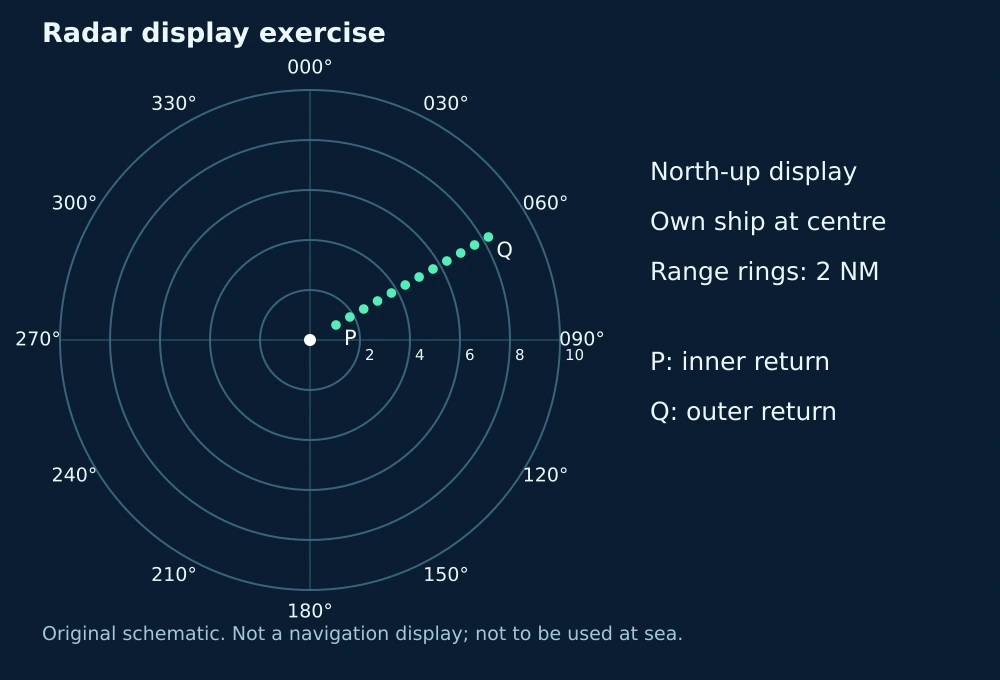
Original schematic for reading practice. The inner end P is the useful range indication. North is at the top; the line lies on 060 degrees. Range rings are two nautical miles apart. The picture is not an operational navigation display.
The battery specification and the test procedure belong together. A typical syllabus radar-SART endurance statement is 96 hours of standby followed by eight hours of response operation; that is not 104 hours of continuous active response. Use only the manufacturer’s short test procedure, inspect condition and expiry, and restore normal stowage. For the cited US survival-craft equipment rule, batteries are replaced after emergency use or at the specified useful-life point; appearance alone does not establish remaining capacity. 80.1095(c); FCC Element 7 topic 41 for SART endurance. topic 41, SART endurance.
Survival VHF equipment supports channel 16 and at least one additional frequency in the specified maritime band. SAR aircraft and vessels may coordinate on mutually supported on-scene channels; 123.1 MHz is one listed aviation/maritime on-scene frequency, while 121.5 MHz has specific limitations and a shift-to-123.1 provision. A listed frequency is not proof that every survival radio can tune it. Know the actual carried equipment and the coordinator’s instructions. 80.1077 and 80.369(e)(1).
The RCC coordinates resources; an assisting master still has responsibility for the safety of the assisting vessel. Position reports need observation times because current, wind and elapsed time can move survivors. Supply relevant updates, persons on board, casualty description, available assistance and constraints. The onboard IAMSAR guidance supports situation reporting and coordination; a short automatic alert does not contain the entire rescue picture. topics 47–48 and 76.
G — VHF voice and bridge-to-bridge work
VHF communication is predominantly line of sight. Antenna height can extend the normal radio horizon; turning up the loudspeaker cannot. Use enough transmitter power for reliable communication without unnecessary interference. Squelch sets the threshold below which reception is muted: excessive squelch can hide a weak but usable call, while volume changes the audio level. A quiet loudspeaker with squelch fully closed does not prove the channel is free. topics 49–50.
In the US channel plan, channel 13 is the main bridge-to-bridge navigation channel, channel 16 is the international voice distress/calling channel and channel 70 is DSC only. Channel 22A, 157.100 MHz simplex, is used for the appropriate Coast Guard follow-on traffic when directed. Channel-plan settings matter: do not infer a US A-channel assignment solely from a similar number on another national configuration. 80.371(c) and 80.374.
Bridge-to-bridge calls explain readily identifiable position, movement and intended action so vessels can understand each other. The rule permits more than one watt in three cases: emergency; failure to respond to a second low-power call; and a broadcast call in a blind situation such as rounding a river bend. The ship name may replace the call sign on the authorized bridge-to-bridge channel. The purpose is navigation, not general company administration. 80.331 and 80.102(c).
For ordinary telephony, the general identification rule requires identification at the beginning and end and at 15-minute intervals during sustained transmissions longer than 15 minutes, with stated exceptions. An automated call setup can affect the details, but does not justify inventing a blanket rule that no identification is ever needed. In a weak exchange, standardized words and clear pauses help more than speaking faster. 80.102.
H — Maritime safety information: NAVTEX, EGC and HF
Maritime safety information includes navigational and meteorological warnings and other urgent safety-related information. Receiving it is an ongoing task: the warning that changes a voyage decision may arrive before the ship encounters the hazard. NAVTEX supplies a coordinated coastal broadcast service. International NAVTEX uses 518 kHz with English text; national services use 490 kHz or 4209.5 kHz. Stations share the international frequency through coordinated time slots, coverage planning and appropriate transmitter power, not through acknowledgements from every ship. sections 2–4.
A NAVTEX identity has four technical characters before the message text. In the example BA27, B identifies the transmitter, A identifies the subject category and 27 is the serial number. The transmitter identifier is not a ship MMSI, and the subject letter is not a measure of signal strength. An error-free message identity can be stored so a subsequent identical transmission does not print again. Missing repeat printouts therefore do not by themselves establish receiver failure. sections 3 and 6; message format and receiver operation.
Select the relevant stations and optional subjects for the route, while preserving mandatory information. Under the current NAVTEX Manual, categories A, B, D and L cannot be deselected: navigational warnings, meteorological warnings, search-and-rescue information and additional navigational warnings. Technical serial 00 is exceptional: it overrides selection and is displayed or printed whenever received. It should not be confused with an ordinary numbered message whose duplicate can be suppressed. Use the current manual here rather than copying an older question’s suggestion that mandatory categories can be disabled. receiver requirements and technical characters B2–B4.
Build a warning picture before departure. The manual recommends switching the receiver on at least 12 hours before sailing, or preferably leaving it on continuously. Turning it on for one minute cannot collect scheduled broadcasts that have not occurred. Check reception, station selection and unread messages, then evaluate whether the warning affects the planned route. NAVTEX service coverage is a planned radio service area, not a promise that a particular ship will receive every broadcast at a fixed range. guidance for mariners.
Enhanced Group Calling provides another distribution method. In the Inmarsat-C system described by the FELCOM18 manual, SafetyNET carries maritime safety information, while FleetNET addresses selected subscriber groups. A private company bulletin is not automatically a SafetyNET warning. Geographical addressing also matters: the terminal uses valid own-position information to determine whether the ship is within an addressed area. A stale position can therefore harm reception decisions even while the satellite signal remains strong. sections 3.4.1–3.4.2, EGC setup and reception.
A NAVAREA is a geographical coordination area for navigational warnings, not a satellite ocean region or the vessel’s licensed sea area. For a forthcoming route into another NAVAREA, configure the relevant additional area in the terminal and maintain valid position data. Selecting an additional area does not excuse disabling the present one prematurely. If an installation cannot receive EGC during a normal traffic session, a separate EGC receiver can provide the needed reception continuity; selecting a different warning area alone does not change the hardware’s simultaneous-reception limitation. sections 3.4.1–3.4.2 and system overview.
HF can distribute MSI through NBDP broadcast reception. For example, 8416.5 kHz is an HF MSI frequency, whereas 8414.5 kHz serves DSC, 8291 kHz serves voice distress traffic and 8376.5 kHz serves distress NBDP in the corresponding band. A broadcast receiver uses FEC rather than establishing an ARQ connection that requires transmissions from every listener. Match frequency, emission and schedule: a strong signal with the wrong decoding mode does not become readable safety text. 80.1077; HF MSI and distress frequency table. topics 57 and 94–95, FEC broadcast reception.
If a distress-priority EGC message requests nearby vessels’ positions and assistance capabilities, read the text, notify the master and respond as instructed to the coordinating authority. Receipt of the broadcast does not mean the terminal has already reported the ship’s ability to assist. Keep an operational distinction between a general warning to be evaluated for the route and a coordination request needing an answer. topics 54–58.
I — Satellite equipment, routing and address formats
Start with the difference between satellite architecture and a particular terminal’s controls. Inmarsat-C uses geostationary coverage and a normally omnidirectional ship antenna, with low-rate store-and-forward messages rather than live voice. A tracking broadband dish is different equipment. An operator who responds to every satellite fault by trying to adjust dish azimuth has not identified which installation is actually involved. system overview and antenna unit.
The network coordination station, NCS, coordinates operation in its ocean region. A land earth station, LES, connects the message service with terrestrial destinations. A terminal first acquiring the NCS signal has synchronized, but that alone does not establish successful login for normal message service or delivery of a message. The FELCOM18 manual also permits distress transmission and EGC reception without ordinary login; do not convert a login rule for routine traffic into a claim that every safety function is impossible beforehand. sections 3.3–3.4 and system overview.
Use the actual terminal status and diagnostic results at power-up. An antenna-power fault calls for investigation using the manual and reporting the defect; a lit power lamp proves less than a successful readiness check. Before a permitted intentional shutdown, complete logout so the network records the terminal as unavailable. After changing ocean region, check region/NCS selection, completed login and the relevant distress and MSI settings instead of relying only on a signal-strength bar. sections 2.1, 3.3–3.4.
In the current downloadable FELCOM18 manual’s table, POR/APAC is associated with 143.5° E. The table also identifies AOR-West/AMER, AOR-East and IOR/EMEA. These service labels and satellite assignments should be read from the equipment’s current documentation. They are not the same thing as the geographical NAVAREAs selected for warnings, and changing one setting does not necessarily change the other. ocean-region table and section 3.3.
The distress LES setting determines shore routing, not merely the ability to hear the satellite. When a region change produces an invalid-distress-LES warning, select a valid LES using the current service information and the manual. Successful NCS synchronization does not make that warning irrelevant. During an emergency, provide follow-on information about position and time, persons on board, casualty conditions and assistance needed; the short alert is only the beginning of coordination. distress LES selection and distress alert procedures.
Iridium uses low-Earth-orbit satellites in near-polar orbital planes, which explains its high-latitude coverage. Its omnidirectional antenna still needs a suitable clear view of the sky and installation compliant with the manufacturer’s requirements. “Omnidirectional” describes an antenna pattern, not an ability to receive through every metal obstruction. Nor should the operator assume that an Iridium GMDSS terminal automatically becomes a terrestrial cellular telephone near shore. topics 63 and 70.
For a concrete current equipment example, the LT-3100S manual distinguishes automatic and manual RCC selection. Automatic selection routes by the vessel’s area; manual selection uses the chosen RCC regardless of geographical position. With Auto-dial enabled, the terminal initiates the distress voice call after alert delivery. When an external alarm panel initiates the alert, check delivery and subsequent communication status on the control unit. These are model-specific instructions, not a universal button sequence for every satellite system. Rev.1.10, distress alert, RCC selection and Auto-dial sections.
Ordinary FleetBroadband connectivity is not by itself the complete Fleet Safety installation. The described architecture includes a dedicated Maritime Safety Terminal alongside the broadband system, providing the safety-service interface and functions. A routine webmail account or an internet connection does not establish the required distress and MSI capability. Whether a particular ship installation meets its applicable approval and carriage requirements must be established for that installation. Fleet Safety launch and MST architecture.
A tracking antenna can lose its satellite line of sight when a course change places a mast or other shipboard structure in the path. Signal loss after the turn is therefore not proof that the vessel has crossed the satellite footprint boundary. Check the actual indications and obstruction geometry, and use the prescribed troubleshooting process. If soot accumulates on a radome, arrange safe cleaning using the manufacturer’s instructions; unapproved coatings or solvents can create another problem. topics 64–67.
Addressing is easier when the operator identifies the bearer, destination type and required fields before entering digits. An Inmarsat-C ship-telex address uses the relevant ocean-region code with the destination mobile number: the examined codes are 581 for AOR-East, 582 for POR, 583 for IOR and 584 for AOR-West. A land-telex address uses the telex country code and subscriber number. It does not use an ordinary telephone country code simply because both fields contain digits. section 3.7.1, destination list.
Worked addressing example: for a land-telex exercise with the supplied code 51 and subscriber 246810, the combined destination is 51246810. First identify the destination as land telex; then concatenate the supplied code and subscriber number. Do not add a voice telephone access prefix or the ocean-region code for a ship terminal. These are instructional numbers, not instructions to contact a live subscriber. section 3.7.1, TELEX destination format.
Fax, email and SMS use their own supported destination types. The FELCOM18 fax-address format uses the international telephone country code followed by the national number. An email address belongs in the appropriate recipient field, not merely in the body text. A supported SMS service uses the recipient mobile number beginning with its country code. Availability and routing depend on the provider and installed equipment, so an archived exam address convention is not proof that a service is available on a particular voyage. section 3.7.1, FAX, E-mail and SMS destinations.
Priority is also a service setting rather than a magic word in prose. Typing PAN PAN in a routine message body does not by itself select the required satellite urgency routing. Use the supported safety service and the actual equipment procedure; the manual’s special-service destination codes are distinct from ordinary recipient addresses. Where a voice follow-on is available, prepare the information needed by the RCC rather than assuming a text label completes the emergency exchange. special-service destination settings and distress procedures.
Fleet 77 is retained here only as historical exam knowledge. The MCA notice records withdrawal of the service on December 1, 2020. Its appearance in the adopted Element 7 pool does not mean a new service can now be purchased. In the legacy dialing convention used in the study questions, 00, country code, subscriber number and # have distinct roles; do not transfer that whole syntax into a different current terminal’s address fields. MIN 617, service withdrawal. topic 69, historical dialing convention.
For a current contrasting example, the LT-3100S manual permits an international phone number beginning with 00 and the country code. Given code 44 and national significant number 2079460123, the number is 00442079460123. The country code is supplied by the exercise; no national trunk prefix is being added. Knowing which system you are using prevents accidentally entering an Inmarsat ocean-region code or a radiotelex command in a voice phone field. Rev.1.10, telephony and contact-number format.
J — MF/HF voice, radiotelex and fault recognition
Simplex operation uses the same frequency for alternating transmission and reception. In a paired arrangement, the ship’s receive setting must match the coast station’s transmit frequency, while the ship transmits on the corresponding ship frequency. Half-duplex operation does not mean that the two ends can ignore that pairing. Identify whose transmit frequency a table describes before programming a radio; confusing the two directions can leave both operators listening in the wrong place. topics 81–82.
An ITU channel designation is not a universal manufacturer memory position. In the conventional HF numbering examined here, channel 1604 identifies channel 4 in the 16 MHz band, not a frequency of 1604 kHz or a variation of VHF channel 16. Verify actual transmit frequency, receive frequency and emission against the current assignment and station service information. ITU List IV concerns coast and special-service stations; List V concerns ship stations and identity assignments. topics 14, 82 and 85.
Before a routine call, listen on the relevant channel and use the station’s published procedure. Once a coast station has established contact by call and reply on 2182 kHz or channel 16, it must shift to an authorized working channel for the ordinary message exchange. A saved frequency or a successful connection does not grant authority to occupy the calling channel indefinitely. 80.92 and 80.111(c).
HF path selection depends on ionospheric conditions, time, path and season. Higher bands often become useful by day, with lower bands worth trying after dark; these are starting guides, not guarantees. Compare the authorized choices and actual received conditions. A strong stable coast free signal is a better starting point for an available radiotelex channel than choosing the highest number simply because it looks more powerful. VHF does not acquire the same long-distance ionospheric behavior merely because night falls. topics 96–97.
NBDP means narrow-band direct printing; the syllabus also uses SITOR for the maritime radiotelex system. ARQ is a two-way error-control arrangement. The information-sending station transmits a three-character block, then the receiving station’s control response determines whether the next block can follow or the current one must be repeated. An acknowledgement belongs to the radio-link process; it does not prove that a human recipient has read or acted on the message. topics 87–88 and 92.
FEC supports one-way reception without requesting a repeat from every listening ship. Conventional NBDP FEC transmits each character twice with a time separation, allowing time diversity to help reception. Broadcast FEC addresses the receiving population, while selective FEC can address a selected station without requiring that station to transmit. The seven-unit constant-ratio code helps detect invalid received characters. It does not guarantee that every corrupted character becomes detectable or that all errors can be reconstructed without redundancy. topics 88 and 93–95.
Worked arithmetic: 30 information characters in complete three-character ARQ blocks require 30 ÷ 3 = 10 information blocks, before control signals or repetitions. A 30-character FEC example with two transmissions per character produces 60 character transmissions before phasing and other overhead. These are different quantities; neither is a calculation of the complete airtime of a real connection. topics 88 and 92–95.
A conventional automated ARQ coast station follows a command sequence. Establish phasing, allow the answerback exchange to complete and wait for the station’s go-ahead prompt. GA+? means that the station is ready for the service command. Check the destination answerback before sending the message, because a working radio path can still lead to the wrong terrestrial terminal. Sending text while the automatic system expects an address command is a procedural error, not necessarily a propagation failure. topics 89–91.
The examined direct-connect convention forms DIRTLX followed by 0, the telex country code, subscriber number and +. This command asks the coast station to establish the terrestrial connection; it is not the address field of an Inmarsat-C terminal. The conventional OBS+ command requests handling of a synoptic weather observation. Follow the actual service instructions when operating, because the continued inclusion of a command in an examination topic does not establish that every coast station still supplies that service. topics 91 and 93.
Keep three endings separate. NNNN marks the end of the message text. KKKK ends the land telex connection while retaining the radio connection for the remaining service exchange, such as time and charges. BRK+ ends the conventional ARQ radio connection. In the examined manual ship-to-ship convention, +? changes the direction of information flow. Confusing these controls can terminate a link before the intended message or service information is complete. topics 90–92.
For a DSC routine call on MF/HF, select the intended station identity, proper category and suitable follow-on mode/frequency. For an alert, check its received record or printout and the announced subsequent traffic. The audible alarm is only an attention signal. A controller that has returned to a normal display has not thereby cancelled the incident, and an automatically selected setting should still be consistent with the service: voice on a DSC-only frequency is not an acceptable follow-on. topics 86 and 98.
A suppressed-carrier J3E transmitter can show near-zero RF output when keyed without speech. If a correctly configured set still produces no output while the operator speaks during an authorized test, investigate and report the suspected fault using the manual. Do not declare every low silent-carrier reading a failure, or every missing speech output normal. An emergency antenna arrangement likewise needs the equipment’s specified method, safe clearances and qualified assistance; arbitrary wire attached to the output is not a general repair procedure. topic 100; Element 1 topics 17–19. topics 17–19, equipment tests, faults and antennas.
Battery knowledge completes the fault picture. Six series cells each at 2.1 V give 12.6 V in the simplified model; series connection adds voltage, not each cell’s ampere-hour capacity. A weak cell can be driven into reverse polarity during continued deep discharge of the string. Use the manufacturer’s charging limits for the installed battery type, and interpret hydrometer readings with the proper temperature correction where that measurement is applicable. One brief successful radio test does not establish the battery’s full reserve capacity. topic 99.
A preparation sequence and how to use the learning bank
Start with functions and jurisdiction: explain what alerting, follow-on communication, MSI and locating each do, and identify when a question asks for current US rules or an explicitly historical convention. Move next to frequency units, emission types and identities. You are ready for procedures when you can explain why an MMSI, an IMN and a telex address cannot be exchanged merely because they are all numeric.
Then work through distress, urgency and safety cases. Say the reasoning aloud: what is the danger, which category applies, which service carries the alert, which channel carries the follow-on, who normally acknowledges and what changes in the relay case? Continue with NAVTEX/EGC and satellite addressing, then MF/HF radiotelex and maintenance/logkeeping. Use the actual equipment manual in supervised training for control sequences; this reading plan is an AnyTest study recommendation, not an official course timetable.
Use short worked examples before a long attempt. Convert a frequency without losing its unit; form a supplied address in the specified system; identify the inner end of a radar SART response; calculate a simplified battery load. After an error, write which condition you missed and which source resolves it. “I confused routine login with distress capability” is more useful than copying the correct option letter.
The linked FCC GMDSS Elements 1 and 7 learning test contains 206 original questions. It shows the complete bank in shuffled order, with no timer, random subset or pass threshold. Single-choice questions have one correct answer. Numeric questions require only the number in the stated unit, with no unit text or thousands separator. Each question has an explanation and source; attempt it before reading the explanation. The practice settings deliberately differ from the separately examined Elements 1 and 7.
Repeat the areas whose reasoning you cannot yet explain, then try the whole bank again without using the explanations as a prompt. A high score in this learning bank is feedback on this material, not proof of practical competence or an FCC examination result. Before booking, verify the examiner’s current pool, examination arrangements and required documents through the linked examiner information and current FCC rules.
Read Part 13 for the qualification and examination route, Part 80 for the US operating requirements, ITU M.541 for the cited DSC procedures and M.585 for identity formats. Use the NAVTEX Manual for message selection and receiver behavior. Use the actual manufacturer manual for controls, addressing and faults. The linked documents are publicly accessible references where available; the FCC archived-pool provenance and the inaccessible live endpoint are disclosed above. No paid course is needed to read this guide, while any official training or assessment obligation remains separate.
Sources, editions and visual provenance
FCC / eCFR, 47 CFR Part 13, commercial operator qualifications; current text through November 25, 2026. Checked November 28, 2026. Read source.
FCC / eCFR, 47 CFR Part 80, maritime radio operation and GMDSS; current text through November 25, 2026. Checked November 28, 2026. Read source.
FCC, Commercial Element 1 Question Pool, approved June 25, 2009; read through an archived official PDF. Checked November 28, 2026. Read source.
FCC, Element 7 Question Pool, adopted October 6, 2021, with internal heading 2019; read through an archived official PDF. Checked November 28, 2026. Read source.
FCC, DA 21-1250, adoption notice, October 6, 2021. Checked November 28, 2026. Read source.
ITU-R M.541-11, operational DSC procedures, November 2023. Checked November 28, 2026. Read source.
ITU-R M.585-10, maritime identities, April 2026. Checked November 28, 2026. Read source.
IMO, MSC.1/Circ.1403/Rev.2, NAVTEX Manual, November 28, 2022, effective January 1, 2023. Checked November 28, 2026. Read source.
Furuno, FELCOM18 Operator’s Manual, current downloadable English manual checked November 28, 2026. Checked November 28, 2026. Read source.
Lars Thrane, LT-3100S GMDSS User & Installation Manual, Rev.1.10, December 2025. Checked November 28, 2026. Read source.
NOAA SARSAT, 406 MHz Emergency Distress Beacons. Checked November 28, 2026. Read source.
NOAA SARSAT, Preventing False Alerts. Checked November 28, 2026. Read source.
UK MCA, MIN 617, Fleet 77 withdrawal notice, April 2020; historical notice, not a current operating regulation. Checked November 28, 2026. Read source.
Inmarsat, Fleet Safety launch and MST architecture, May 9, 2022. Checked November 28, 2026. Read source.
IMO, MSC.496(105), SOLAS amendments adopted April 28, 2022, effective January 1, 2024. Checked November 28, 2026. Read source.
US Captains Training, current Element 1 examination and booking information. Checked November 28, 2026. Read source.
US Captains Training, current Element 7 examination and booking information. Checked November 28, 2026. Read source.
The explanations, exercises, cover and diagrams are original AnyTest educational material. The radar illustration is an idealized learning schematic, not a capture from an operating radar or a navigation aid. No manufacturer artwork or interface screenshot has been copied. Source documents support facts; their illustrations and layouts remain with their respective rights holders. No FCC, IMO, ITU or manufacturer endorsement is implied.