Demolition safety is a sequence of decisions: establish what is present, understand what holds it up, choose a controlled method, and check that the assumptions still match the work. A correct answer is useful when you can explain why a plausible shortcut would fail. This guide develops that reasoning for people preparing for the Great Britain CITB Health, Safety and Environment Specialist Demolition test.
Our accompanying bank contains 105 original questions about core construction safety and demolition. It uses public CITB scope information, HSE guidance and environmental-regulator sources checked on 28 November 2026. The detailed paid GT100 question book was not inspected. We therefore do not claim a question-by-question or exhaustive detailed crosswalk to that book, reproduce its official questions, or present our bank as a complete examination simulation. Sources: CITB: Specialist HS&E tests, CITB: Prepare for the HS&E test.
What the official test establishes
CITB lists Demolition as the DEM specialist test. Specialist tests include the five core knowledge areas in the Operatives test and relevant specialist questions. The published core labels are Working environment, Occupational health, Safety, High risk activities and Specialist. The test has 50 questions, allows 45 minutes and requires at least 45 correct answers. CITB's current Internet Test Centre rules, version 2.1 of April 2026, also confirm 50 questions and 45 minutes. The public sources checked do not establish a current detailed question allocation between core and demolition, so we do not invent one. Sources: CITB: Specialist HS&E tests, CITB: Operatives HS&E test, CITB: ITC Scheme Rules v2.1 April2026.
Use CITB's official preparation page to obtain the current material: it specifies GT100 sections A–E plus the relevant chapter in section F for specialists. The shop currently lists GT100-V14.1. CITB also links a demonstration of question styles and its booking and support arrangements. Confirm the appropriate test for your intended card or role through the official route; passing this awareness test is not itself proof that you can safely operate a particular machine, design temporary works or remove asbestos. Those activities need their own relevant competence, training and controls. Sources: CITB: Prepare for the HS&E test, CITB: GT100 revision material, CITB: Specialist HS&E tests, HSE: Construction workers, roles and responsibilities, HSE: Asbestos information, instruction and training.
Start with the site, the task and the people
A general qualification cannot tell you where today's exclusion zone ends, which escape route remains open or where the first-aid provision is located. Site induction supplies that local information. It should cover particular hazards and controls, the project's management, first aid, incident reporting, ongoing briefings and workers' responsibilities. Visitors also need information proportionate to their visit. An escort reduces the amount of detail a visitor may need; it does not remove the need to explain the hazards they could encounter. Sources: HSE: Site rules and induction.
Understanding matters more than signing. If an instruction is unclear, ask for an explanation before doing the affected work. Workers must follow site rules, cooperate with dutyholders and report risks to the person controlling the work, including risks to other subcontractors or the public. When two instructions conflict, the safe response is to obtain a coordinated instruction, not choose the more convenient route. A changed demolition stage may require a fresh briefing even for an experienced team. Sources: HSE: Construction workers, roles and responsibilities, HSE: Site rules and induction.
Worked example: a route changes. Yesterday, a corridor was the way to the welfare unit. Today, the method places part of it inside a debris zone. The worker's earlier induction does not make yesterday's route safe today. First identify the changed restriction, then obtain the current access arrangement and communicate it to affected people. Changing a drawing in the office without changing what workers understand leaves the practical risk in place. This example applies the duties to communicate site rules and report hazards. Sources: HSE: Site rules and induction, HSE: Construction workers, roles and responsibilities, HSE: Demolition.
Welfare and reporting are working controls
Welfare must be available from the start of the project until it ends. Toilets, washing, changing, eating and rest arrangements are not a reward for completing the first demolition stage. Suitable washing includes running hot and cold or warm water, cleaning means and drying facilities. A small hand-sanitiser dispenser alone is inadequate. Where an agreed nearby facility is used, it must be available whenever people are working, with suitable cleaning and supplies. Sources: HSE: Welfare overview, HSE: Toilets and washing.
Contamination control continues during breaks. Keep contaminated protective clothing separate from everyday clothes. Keep the rest area clean and do not use it as a store for plant or demolition materials. Drinking water should be clearly identified and accessible. These arrangements help keep dust or other contaminants out of food and personal belongings; washing and clean eating areas are part of protecting health, not merely comfort. Sources: HSE: Welfare overview, HSE: Changing, eating and rest areas, HSE: Toilets and washing.
Know how to obtain immediate first-aid help. Report injuries, hazards and near misses through site arrangements. That internal reporting is distinct from a formal RIDDOR submission: the responsible person, such as the employer or person controlling premises, makes reports required by that legislation. An employee should inform the employer and raise concerns if necessary; not every minor incident or near miss is a reportable RIDDOR event. Waiting for injury before reporting a falling-object near miss loses an opportunity to prevent harm. Sources: HSE: First aid at work, HSE: Site rules and induction, HSE: Construction workers, roles and responsibilities, HSE: Who should report under RIDDOR.
Control exposure before relying on protection
Construction dust can damage the lungs even where the work is outdoors. Silica-containing materials such as concrete and mortar can generate respirable crystalline silica when worked. Dust can also arise from wood and other materials. The task's energy, duration, frequency and enclosure affect exposure. A clear view across the site is not a measurement of respirable dust, and a breeze is not automatically equivalent to the extraction specified for a tool. Sources: HSE: Construction dust, HSE: Construction dust CIS36 Revision3.
Think in stages. Can the material, method or amount of cutting change so less dust is produced? If dust remains, can it be captured at the tool or suppressed correctly? Water suppression needs the proper supply throughout the work, not just a splash beforehand. On-tool extraction is a system comprising the tool, hood, tubing and suitable extraction unit. If it fails, stop the affected task and restore or reassess the control rather than assuming a window or respirator provides an equivalent substitute. Sources: HSE: Construction dust CIS36 Revision3.
Respiratory protective equipment may still be required with those controls. It must be adequate for the hazard and suitable for the person and work. Tight-fitting facepieces require fit testing, and the tested make, model, type and size must match what is supplied. A successful test is not permission to use any mask labelled with the same nominal size. Check the fit each time the mask is put on. Facial hair in the sealing area can allow contaminated air around the filter; a higher-grade filter cannot repair that leakage. Suitable alternatives that do not depend on a tight face seal are available. Sources: HSE: Fit testing basics, HSE: Construction dust CIS36 Revision3.
Worked example: the mask passes, the system fails. A grinder has a correctly selected respirator and working extraction. The extraction stops mid-task. The remaining respirator does not prove that the assessed combined system is still adequate. Stop the grinding, report the failed control and restore it or obtain a competent reassessment. The key error is treating one surviving part as automatically equivalent to the complete arrangement. Sources: HSE: Construction dust CIS36 Revision3, HSE: How to carry out a COSHH risk assessment.
A COSHH assessment considers the actual process and exposure, not just a supplier's safety data sheet. Ask what can be inhaled, swallowed or absorbed through skin contact, who else could be exposed, and how often. Process-generated dust and fume need assessment even without a label on the original material. Prefer prevention, substitution, containment or suitable extraction before defaulting to PPE. Use controlled cleaning; dry sweeping or compressed air can return settled dust to the air. Lead and asbestos have their own specific regulatory controls rather than being treated as ordinary COSHH substances alone. Sources: HSE: How to carry out a COSHH risk assessment.
Noise, vibration, handling and pressure
Noise control starts with assessment and measures to reduce exposure. Hearing protection supplements other controls where those do not reduce exposure sufficiently; it does not protect people who are not wearing it. Keep the different numerical concepts separate: the lower daily or weekly action value is 80 dB(A), the upper is 85 dB(A), and the exposure limit is 87 dB(A). Peak values use dB(C) and are a different measure. These are exposure values, not a reason to judge an entire shift from one casual sound reading. Sources: HSE: Noise employers’ responsibilities.
Hand-arm vibration can damage nerves and blood vessels. Tingling, numbness, loss of sensation or strength, and fingers becoming white in cold conditions are signs to report promptly. Do not wait for every sign to appear. Consider a method without vibration, then suitable lower-vibration equipment, correct maintenance and controlled exposure. A worn cutting tool may make the job slower and increase exposure. Avoid unnecessary gripping force and use the planned work pattern rather than treating discomfort as a normal training effect. Sources: HSE: Worried about your hands?.
Manual handling assessment extends beyond weight. Bulky panels can obstruct vision; awkward grips, twisting, uneven ground, repetition and the worker's capability all matter. Prevent or reduce handling through suitable lifting aids, delivery locations and work layout where possible. Technique training adds value but does not replace those measures. For example, repeatedly carrying material across rubble should prompt a review of the route and handling method, not only a reminder to bend the knees. Sources: HSE: Construction manual handling.
Work pressure also deserves attention. Changed concentration, behaviour or motivation may have several causes and should not be used to diagnose a colleague. They can, however, be reasons to raise a concern early with a manager, colleague or health professional. Employers must assess work-related stress risks and address causes. Waiting for an incident makes support harder and does not resolve unsafe demands. Sources: HSE: Work-related stress, signs.
Read signs and choose compatible PPE
Signs communicate a specific kind of message. A blue circle with a white pictogram requires an action, such as wearing head protection. A yellow triangle warns of a hazard. A red prohibition sign forbids a behaviour, while green escape and first-aid signs identify safe conditions and facilities. Read the symbol and context, not colour alone. Signs must be visible and understandable, and they support rather than replace measures such as physical separation and guarding. Sources: HSE: Safety signs and signals L64 third edition2015, HSE: Traffic management on site, HSE: PUWER overview.
Required PPE must be suitable, provided free of charge and accompanied by information and training. Check the combination: eye protection that interferes with a respirator seal can undermine protection. Omitting one item or wearing a mask loose is not a solution. Select and check compatible equipment for the assessed risks. A helmet can reduce some injury risks, but it cannot make walking beneath an uncontrolled suspended load acceptable. Sources: HSE: Using PPE to control risks, HSE: Fit testing basics, HSE: Planning and organising lifting operations.
Fire precautions must change with the building
Demolition and alteration change access, fire separation and available exits. Keep suitable escape routes open and ensure the alarm can be recognised above the working noise. Go to the designated safe assembly place so people can be accounted for. A route on an old plan is not an escape route if today's partition blocks it. In occupied premises, consider the effects on other occupants' existing fire precautions as well as the demolition team's arrangements. Sources: HSE: General fire safety.
Hot work introduces ignition into a changing environment. Remove or control combustible material, provide suitable firefighting provision and maintain the required watch. A permit can organise the control process, but its signature cannot prevent ignition by itself. A redundant tank that looks empty may still contain flammable residues or vapour. Cleaning, checking, isolation and specialist advice may be needed before any hot work; appearance or lack of smell is not a gas-free certificate. Sources: HSE: Process fire risks, HSE: Maintenance of work equipment.
Electrical safety and stored energy
Do not infer that a cable is dead because lights no longer work or a building is vacant. Competent people must understand the relevant supplies and follow safe isolation procedures before work liable to disturb the system. For suitable site tools, a 110 V centre-tapped-to-earth supply limits the voltage to earth to 55 V, but that does not make damage harmless. Remove damaged tools or leads from service and arrange competent repair; makeshift repairs are not an acceptable shortcut. Sources: HSE: Electricity, systems in buildings.
An RCD provides additional protection against some faults, not every electrical hazard and not proof of isolation. Machinery also has energy beyond electricity. Hydraulic pressure, compressed air, raised components and gravity can remain dangerous after a normal stop. Isolate appropriate energy sources, prevent unexpected reconnection where necessary, release stored energy and support parts that could fall. Maintenance requires competent people and a planned safe system; a watcher at the stop button does not substitute for required isolation. Sources: HSE: Electricity, systems in buildings, HSE: Maintenance of work equipment, HSE: PUWER overview.
Guards, interlocks and other protective measures prevent access to dangerous machine parts. Removing a guard and adding a warning label does not deliver the same protection. Equipment must be suitable for the task, maintained and used by trained people whether it is owned or hired. Conformity marking and instructions are relevant checks, but neither proves that a particular machine remains undamaged or is suitable for today's work. Sources: HSE: PUWER overview.
Height, ground and movement
Work at height is about a fall liable to cause injury, not a universal two-metre threshold. First consider avoiding it; then prevent falls; then minimise remaining fall distance and consequences. Prefer collective protection where appropriate before relying on personal systems. A harness requires suitable attachment and a plan for recovery after a fall. An equipment inspection does not supply that rescue method. Ladders are not a default platform for prolonged heavy breaking work, and a roof sheet's sound appearance does not establish that it can bear a person. Sources: HSE: Introduction to working at height safely.
Excavations can collapse in ground that looked firm. Plan support or battering, safe access, edge protection, loading and water control. Keep plant and spoil loads from compromising the sides. Competent inspection is needed at the start of a shift and after events that may affect stability, including a fall of material. Heavy rain can make yesterday's conditions irrelevant; merely pumping water away does not establish stability. Excavation can also undermine adjacent walls, scaffold foundations and services. Sources: HSE: Excavations.
Buried-service plans indicate what may be present; locating and safe digging practices help establish the actual position. These elements complement one another. A locator used once far from the excavation does not clear the work area. Overhead lines require planning too: danger can arise from close approach and flashover, not only contact. Consult the line owner about the work and required clearances, considering avoidance, diversion or isolation first. Do not copy a clearance from a different line or judge it by eye from the cab. Sources: HSE: Electricity, underground cables, HSE: Electricity, overhead power lines.
Separate people from vehicles with suitable routes, barriers and controlled crossings. Prevent blocked walkways from forcing pedestrians into plant paths. Avoid reversing where practicable, and use trained, authorised signallers where the arrangements require them. High-visibility clothing helps people be seen but is not a qualification to direct a machine. Lifting operations likewise need planning appropriate to the load, location and risk, including ground stability and proximity to excavations. Restrict access beneath loads suspended for significant periods. Sources: HSE: Traffic management on site, HSE: Planning and organising lifting operations.
Confined spaces: recognise the combined conditions
A confined space is enclosed or largely enclosed and has a reasonably foreseeable specified risk, such as asphyxiation, drowning, fire or explosion. It need not be small. Avoid entry where possible; otherwise assess and control the particular risks with competent people and appropriate arrangements. Yesterday's safe atmosphere is not a guarantee for today. If someone collapses, an unprotected rescuer can become another casualty. Plan how to know the person is safe and recover them; reliance only on emergency services is insufficient. Sources: HSE: Introduction to working in confined spaces.
Demolition begins with information and a written method
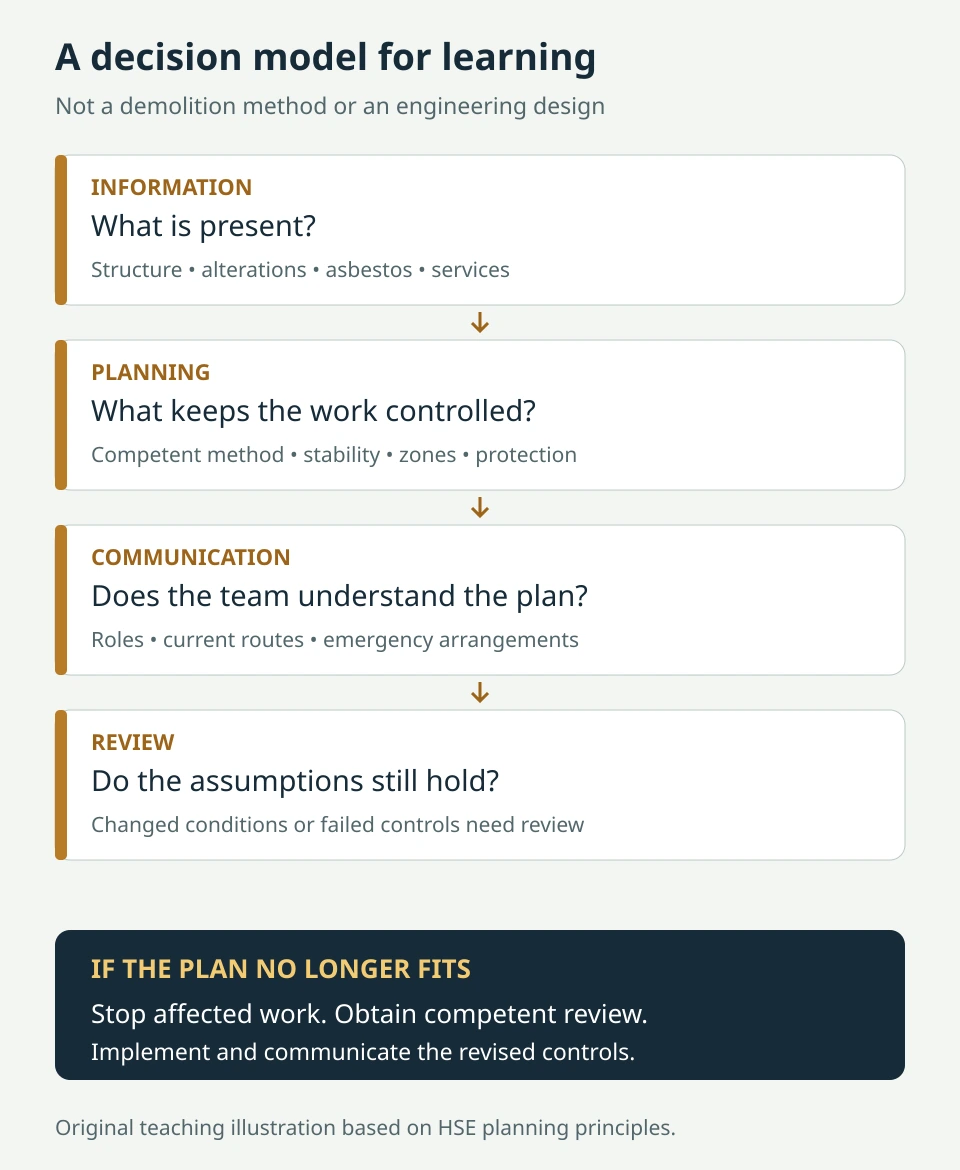
For projects with these dutyholders, the principal designer manages pre-construction health and safety, while the principal contractor manages the construction phase. The client must provide relevant information and appoint suitably capable people. Before selecting the method, establish the structural form and condition, historical alterations, nearby structures, asbestos and live services. A competent structural survey is needed before potentially load-bearing parts are altered. The arrangements for demolition or dismantling must be recorded in writing before the work begins. Sources: HSE: Demolition, HSE: Structural stability during alteration, demolition and dismantling.
A management asbestos survey for normal occupation is not automatically sufficient for destructive work. A suitable refurbishment or demolition survey locates hidden ACMs before structural work. Read its limitations: a void that could not be accessed is not thereby asbestos-free. Resolve the restriction and manage the presumption appropriately before the affected work. ACMs must be removed as far as reasonably practicable before major demolition, using appropriate contractors and controls. Awareness training teaches recognition and avoidance, not unrestricted removal. Unexpected suspected asbestos means stop affected work and use the reporting and assessment arrangements. Sources: HSE: Arrange an asbestos survey, HSE: Asbestos information, instruction and training, HSE: A worker’s guide to asbestos safety.
Worked example: an undocumented alteration. A survey and method assume a wall is non-critical. Opening up reveals an alteration that changes that assumption. Continuing to the planned end-of-shift stopping point does not preserve safety merely because it preserves the programme. Stop the affected operation, obtain competent review of the structure and method, implement the revised controls and brief the team. The written method is a controlled plan that can be revised when evidence changes, not an instruction to ignore new evidence. Sources: HSE: Demolition, HSE: Structural stability during alteration, demolition and dismantling, HSE: Construction workers, roles and responsibilities.
Maintain stability through every stage
Buildings remain stable through load paths and restraining elements. Demolition changes both. Cores, bracing, arches, overhangs and adjoining elements may be critical even when they obstruct access. Removal order should preserve stability, not follow material collection schedules. Temporary supports require competent engineering decisions and design for foreseeable loads, followed by correct installation, checking, inspection and dismantling. Standard tied scaffold is generally not structural support: it may itself depend on the building for lateral stability. Sources: HSE: Demolition, HSE: Structural stability during alteration, demolition and dismantling.
Top-down work can offer better control of stability and debris on a constrained town-centre site, but method selection requires analysis of the actual structure and surroundings. A high-reach machine's ability to reach the roof does not prove it is the right method. Plant and accumulated debris can overload remaining floors, especially as supporting elements are removed. If the structure changes between sections, the method may need to change too. Sources: HSE: Demolition, HSE: Structural stability during alteration, demolition and dismantling.
Worked example: room for the machine, but not the debris. A machine fits inside the site fence, yet the predicted collapse could throw debris outside it. Machine access is only one condition. Reassess the method, collapse mechanism, debris area and public protection; do not treat the fence as a physical limit on how far material can travel. A quieter time of day or a banksman watching the boundary does not contain debris. Sources: HSE: Demolition.
Exclusion and debris zones depend on the method, available space and potential spread of material. They may change as the work progresses. A standard scaffold does not automatically justify reducing them. Explosive demolition requires specialist assessment: HSE's still-linked CIS45 explains why height alone cannot determine the zone and assigns its design to the explosives engineer. CIS45 is historical guidance, first published in 1995; its old legislative references are not used here as current law. This guide discusses only the need for specialist planning and exclusion, not explosive techniques. Sources: HSE: Demolition, HSE: Structural stability during alteration, demolition and dismantling, HSE: Establishing exclusion zones when using explosives in demolition CIS45.
Crushing: prevent the intervention
Control feed size, rate and unsuitable material to reduce crusher blockages. Guarding, safe access, separation from loading plant and dust controls remain necessary. A stalled crusher may contain material under stress that can be ejected. Follow the site's written stalled-crusher procedure, stop feed, exclude people and obtain competent investigation. Where someone must enter to position tackle, stop, isolate and lock off the crusher and feeder under the specified procedure. A stopped feeder alone or a radio promise against restart is not equivalent. Sources: HSE: Safe operation and use of mobile jaw crushers, HSE: Maintenance of work equipment.
Waste and water: follow the material beyond the gate
Waste duties do not disappear when a broker is paid. In England and Wales, take reasonable steps to ensure authorised collection and handling, an appropriate destination and an accurate waste description. Secure containers and loads to prevent escape. A facility authorised for one waste type is not automatically authorised for another. Keep hazardous material suitably segregated and identified; do not send it mixed for somebody else to discover later. In Scotland, SEPA likewise requires authorised recipients, secure containment and appropriate waste transfer or special waste consignment documentation, with producers checking its accuracy. Specific procedures depend on the jurisdiction and waste. Sources: Defra/EA: Waste duty of care code of practice, SEPA: Waste duty of care.
Segregation can preserve recovery opportunities, but it does not by itself establish end-of-waste status or remove classification and authorisation duties. Keep the description accurate and make sure the chosen route can accept the material. Covering a skip prevents escape; it cannot compensate for a false description, leaking liquid or unsuitable loading. These are separate parts of managing the waste chain. Sources: Defra/EA: Waste duty of care code of practice, SEPA: Waste duty of care.
Contaminated wash water is not made safe by finding the nearest drain. The Environment Agency's England guidance distinguishes surface water drains, which discharge to the environment, from foul or combined sewer routes that still require the appropriate permission for trade effluent. Collect contaminated water for suitable reuse, treatment or removal where required. A current drainage plan identifies types, directions and discharge points. If a spill has entered or could enter a watercourse or the ground, activate the site response safely and ensure immediate notification through the relevant pollution arrangements. Use the corresponding regulator's guidance for Wales or Scotland. Sources: Defra/EA: Pollution prevention for businesses, updated12Feb2026.
Prepare by explaining the decision
Begin with the official CITB format and revision route. Then work through the broad areas here: site arrangements; health exposure; equipment and emergency safety; height, ground and movement; demolition planning and stability; and environmental control. These lesson groupings are our teaching structure, not a claimed reproduction of GT100's detailed contents. Read the linked HSE guidance for any subject you cannot explain. Use the official question-style demonstration alongside suitable training and current GT100 material. Sources: CITB: Specialist HS&E tests, CITB: Prepare for the HS&E test.
For each scenario, identify the changed condition, the person who controls the decision and the control that actually addresses the risk. A useful error note says why the rejected alternative fails: a record is not a control, a previous successful job is not today's assessment, a mask is not a substitute for failed extraction, and a machine fitting through the gate does not contain a collapse. These are study prompts for reasoning, not a substitute for a competent site-specific method.
Open the 105-question CITB Demolition theory learning bank. It presents all questions in shuffled order, with one correct option each, explanations and primary sources. There is no timer or pass threshold. Review both correct and incorrect choices, then return to the sources for unresolved points. The official 50-question, 45-minute, 45-correct format remains distinct from these learning settings. Sources: CITB: Specialist HS&E tests.
Sources and further reading
CITB supplies the exam scope, format, current revision route and booking information. HSE supplies the construction-health and safety explanations; environmental regulators supply the jurisdiction-specific waste and pollution guidance. The illustrations are original teaching diagrams, not a demolition plan or an engineered exclusion-zone design. All links below were checked during preparation on 28 November 2026.
- HSE: Construction workers, roles and responsibilities — Workers’ duties under CDM2015.
- HSE: Site rules and induction — Site rules; Site induction.
- HSE: Welfare overview — Who; What; Where.
- HSE: Toilets and washing — Washing; Common issues.
- HSE: Changing, eating and rest areas — Changing; Rest and eating; Drinking water.
- HSE: First aid at work — Overview.
- HSE: Who should report under RIDDOR — Responsible people; Employees and representatives.
- HSE: Construction dust — What you must do; What you should know.
- HSE: Construction dust CIS36 Revision3 — pp1–3 Assess, Control, Review.
- HSE: Fit testing basics — When you need fit testing; Facial hair.
- HSE: How to carry out a COSHH risk assessment — Identify; Assess; Control; Review.
- HSE: Noise employers’ responsibilities — Legal duties; Action and limit values.
- HSE: Worried about your hands? — Early signs; How do I protect myself?.
- HSE: Construction manual handling — Assess; Control; Review.
- HSE: Work-related stress, signs — Signs of stress; Workers.
- HSE: Asbestos information, instruction and training — Asbestos awareness.
- HSE: Using PPE to control risks — Overview; When to use PPE.
- HSE: Safety signs and signals L64 third edition2015 — Table1 p12; prohibition/mandatory/escape signs.
- HSE: General fire safety — Means of escape; Means of warning.
- HSE: Process fire risks — Combustible material; Ignition sources.
- HSE: Electricity, systems in buildings — Working dead; Portable electrical equipment; RCDs.
- HSE: PUWER overview — What you must do.
- HSE: Maintenance of work equipment — Safe isolation; Stored energy; Support.
- HSE: Traffic management on site — Separation; People; Visibility; Signs.
- HSE: Introduction to working at height safely — Assessment; Hierarchy; Collective/personal protection; Dos/don’ts.
- HSE: Excavations — Collapse; Falling materials; Services; Inspection.
- HSE: Electricity, underground cables — Planning; Plans; Locators; Safe digging.
- HSE: Electricity, overhead power lines — Planning; Eliminating danger; Controlling access/work.
- HSE: Introduction to working in confined spaces — Definition; What you have to do; Rescue.
- HSE: Planning and organising lifting operations — Planning; Positioning; Suspended loads.
- HSE: Demolition — Responsibilities; Pre-construction information; Method; Stability; Zones; Sequence.
- HSE: Structural stability during alteration, demolition and dismantling — Survey; Collapse prevention; Temporary supports; Written arrangements; Scaffold.
- HSE: Arrange an asbestos survey — Management survey; Refurbishment or demolition survey; Restrictions.
- HSE: A worker’s guide to asbestos safety — Unexpected asbestos; Stop work.
- HSE: Safe operation and use of mobile jaw crushers — Blockages; Stalled crushers; Clearing; Guarding.
- Defra/EA: Waste duty of care code of practice — England and Wales; §§2.4,3.3–3.6.
- SEPA: Waste duty of care — Who duties apply to; Duties.
- Defra/EA: Pollution prevention for businesses, updated12Feb2026 — England; Contaminated water; Drains; Storage; Incidents.
- HSE: Establishing exclusion zones when using explosives in demolition CIS45 — pp1–2 zone assessment and explosives engineer; historical1995 guidance still linked by HSE, not current legal references.
- CITB: Specialist HS&E tests — DEM; five core areas; 50 questions;45minutes;45pass.
- CITB: Operatives HS&E test — Five core knowledge areas.
- CITB: Prepare for the HS&E test — Specialist: GT100 A–E plus relevant F chapter.
- CITB: GT100 revision material — Current product listing V14.1.
- CITB: ITC Scheme Rules v2.1 April2026 — Appendix1 p17.