Understand the rules behind the BIIAB APLH syllabus for England and Wales, with original examples and a linked study test. Sources checked 28 November 2026.
The qualification, the examination and the licence
The BIIAB Level 2 Award for Personal Licence Holders is a knowledge qualification for England and Wales. The public qualification guide v2.3, updated in May 2026, contains one unit: Legal and Social Responsibilities of a Personal Licence Holder, A/616/5204. Its 13 learning outcomes contain 68 assessment criteria. The qualification numbers are 603/2468/5 in England and C00/1212/8 in Wales. Scotland and Northern Ireland have different licensing systems; do not transfer these rules across the border.
The assessment is 40 multiple-choice questions in 60 minutes, taken online or on paper through an approved centre. A pass requires 28 correct answers, or 70%. The specification and assessment are in English. It permits dictionaries but explicitly prohibits bilingual dictionaries; an online calculator is available for online assessment, and a calculator is permitted for paper assessment. Other books and materials are not permitted. Check identification, booking and any reasonable adjustment with the centre. The guide gives eight guided learning hours and ten total qualification hours; those are qualification planning figures, not a guarantee that every learner will be ready in that time.
Passing APLH does not itself grant a personal licence. The certificate supports a separate licensing-authority application, which has its own age, qualification and other eligibility checks. Our questions are original, based on the complete public criteria and current primary rules. Secure-centre indicative content and closed examination questions were not accessed or copied. The public specification is the coverage boundary, not a claim that our questions predict an individual official paper.
Sources: BIIAB qualification guide v2.3 (May 2026), Home Office section 182 guidance (November 2026).
Three permissions that do different jobs
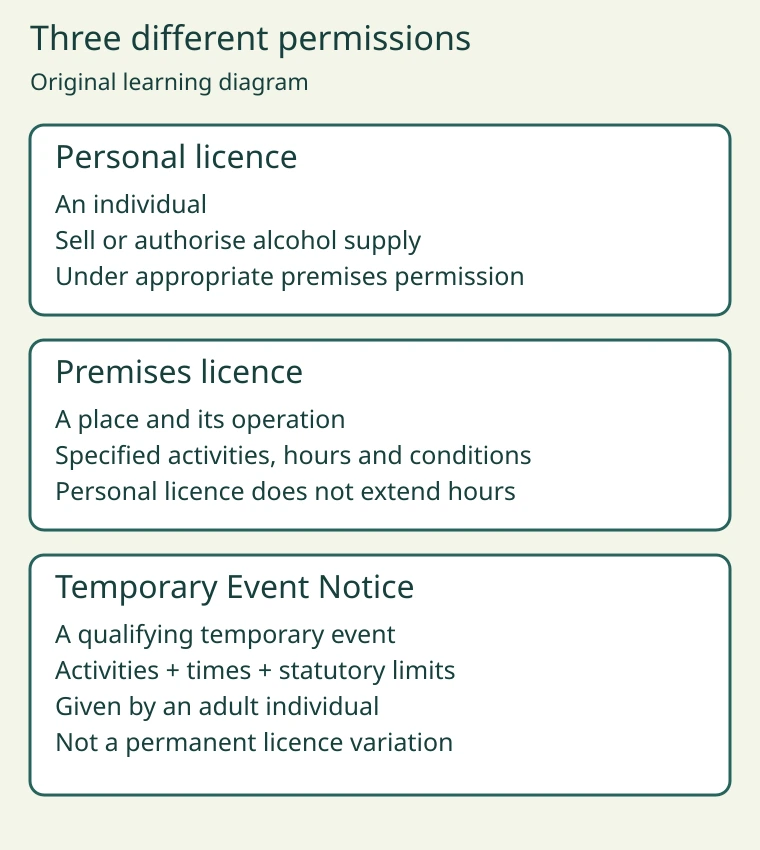
A personal licence is held by an individual and authorises that person to sell alcohol or authorise its supply under an appropriate premises licence. A premises licence authorises specified activities at a place, subject to its conditions. A Temporary Event Notice, or TEN, provides a route for a qualifying temporary event within its statutory limits. Learning which document answers which question prevents many otherwise plausible mistakes.
For example, a qualified manager with a personal licence joins a new restaurant. That personal licence does not permit the restaurant to sell alcohol without premises authorisation. If the premises licence allows sales until 23:00, the manager's individual licence does not extend them to midnight. If the business plans a temporary activity outside its normal permissions, it must check whether a suitable TEN or another change is needed; calling something a private event does not settle its legal status.
Personal licences no longer have routine ten-year renewal. They can nevertheless be surrendered, suspended, revoked or forfeited. For relevant applications made on or after 6 April 2017, a licence granted to a person subject to immigration control lapses if their entitlement to work in the UK ceases. Changing jobs does not itself end the personal licence, nor does moving home transfer it automatically to a new authority.
Sources: Licensing Act 2003, section 111, Home Office section 182 guidance (November 2026).
Applying for a personal licence
An ordinarily resident applicant applies to the licensing authority for the area where they live, rather than where they expect to work. An applicant not ordinarily resident in England and Wales can apply to any licensing authority there. Ordinary eligibility includes being at least 18, holding an accredited licensing qualification unless a specified exemption applies, not having forfeited a personal licence within the previous five years, and meeting the applicable work-entitlement requirements. The application must include its prescribed documents and fee. Employment in a pub is not itself a grant requirement.
Relevant offences are those identified in Schedule 4 of the Licensing Act. A foreign offence is an offence, other than a relevant offence, under the law of a place outside England and Wales. The definition is about the applicable law, not the applicant's nationality. Declaring convictions enables the required statutory checks; hiding one is not made harmless by having passed the qualification.
The police have an objection role on the crime-prevention ground, and the Home Office has a separate role on applicable immigration grounds. Do not import the general public's premises-licence representations process into this personal-licence process. Where the requirements are met and there is no applicable objection, the authority must grant in accordance with the statutory procedure. An objection normally leads to a hearing unless the permitted agreement makes a hearing unnecessary; it is not itself a new criminal conviction.
If a relevant or foreign conviction occurs during the application period, notify the authority as soon as reasonably practicable. Section 123 makes failure without reasonable excuse an offence with a level-4 maximum fine, currently £2,500. Worked example: a learner applies on Monday and is convicted of a relevant offence before the application is decided. The original declaration was accurate when signed, but that does not remove the duty to report the new event.
Sources: Home Office section 182 guidance (November 2026), Licensing Act 2003, section 113, Licensing Act 2003, section 123, Sentencing Act 2020, standard scale.
Keeping the authority and the court informed
After grant, separate a charge, a conviction, a change of details and surrender. For a relevant charge, section 128 requires the holder to produce the personal licence to the court by the first magistrates' appearance, or give the prescribed information and explain why it cannot be produced. If a licence is obtained after that first appearance while proceedings continue, the duty applies at the next appearance. Relevant subsequent events such as surrender or revocation also need the required notification in the proceedings. The public syllabus mentions foreign offences broadly; the precise domestic court-production rule concerns relevant-offence proceedings, so do not invent an identical overseas court procedure.
When a domestic court knows that a person convicted of a relevant offence holds a personal licence, section 131 places a notification duty on the court. Section 132 covers the holder's notification where that court duty does not apply and also foreign convictions. Give the required conviction and sentence details promptly to the relevant authority, including the applicable appeal information. A conviction abroad should not be left unreported on an assumption that another country's court will contact the council.
Notify a change of name or address as soon as reasonably practicable to the authority that issued the personal licence. Include the licence or explain why it cannot be produced. Moving across a council boundary does not change that issuing-authority relationship. For voluntary surrender, give the formal notice and licence, or the required explanation; the licence lapses when the authority receives a valid surrender notice. If the authority requires production for statutory amendments or endorsements under section 134, the specified period is 14 days from notification.
When a holder is at relevant premises to make or authorise alcohol sales, a constable or authorised licensing-authority officer can require inspection under section 135. The authorised officer must show their authority if asked. This is not a general inspection power held by any customer. Several holder-administration breaches, including the relevant name/address and document duties, carry a level-2 maximum fine of £500; the application-stage conviction duty has the different level-4 maximum.
Specified drink-driving offences are relevant offences even when committed away from work. The criminal court can forfeit the personal licence or suspend it for up to six months in the statutory circumstances. Licensing authorities also have specified suspension/revocation powers for qualifying post-6 April 2017 convictions or immigration penalties, with their own process and appeal rights. A conviction is therefore important to licensing, but does not mean that every conviction automatically cancels every licence.
Sources: Licensing Act 2003, section 128, Licensing Act 2003, section 131, Licensing Act 2003, section 132, Licensing Act 2003, section 127, Licensing Act 2003, section 116, Licensing Act 2003, section 134, Licensing Act 2003, section 135, Home Office section 182 guidance (November 2026), Sentencing Act 2020, standard scale.
Authorities, objectives and operating schedules
The relevant local council normally performs the Licensing Act's licensing-authority functions: applications, conditions, variations, reviews and enforcement-related administration. Police, environmental health, fire and other responsible authorities contribute their statutory expertise. They are not interchangeable with the qualification awarding organisation. The November 2026 guidance also describes the Mayor of London's strategic licensing policy and specific call-in arrangements; London applications must be checked against those current provisions rather than an older assumption that no strategic role exists.
The four objectives are prevention of crime and disorder, public safety, prevention of public nuisance, and protection of children from harm. There is no separate fifth public-health objective in the England/Wales Act. Health evidence can still be relevant to one of the actual objectives, while commercial competition or a preference for a particular business model is not itself an objective.
A licensing authority must determine and publish its licensing policy at least every five years. The policy guides decisions but does not override the Act or remove individual consideration. The authority must have regard to section 182 guidance. Hearings allow relevant concerns and responses to be considered through the applicable procedure. An eligible appeal against an ordinary licensing decision is normally commenced in the magistrates' court within 21 days of notification; special procedures need their own rules.
An operating schedule explains the proposed licensable activities, relevant times and practical measures to promote the objectives, with the other required application details. Make it specific to the location. A venue beside homes may need a customer-dispersal and noise-management plan; merely repeating the four objective names does not explain what staff will do. Measures may become licence conditions, so vague promises can create operational confusion.
Partnership working supports the same objectives. A local operator network can share appropriate incident information and coordinate responses without transferring each holder's responsibilities. Community Safety Partnerships bring together police, local authorities, fire and rescue, health and probation partners to tackle crime, disorder and antisocial behaviour. They are not alternative licence-granting bodies. Records, cooperation and agreed procedures help turn broad objectives into consistent action.
Sources: Licensing Act 2003, section 3, Licensing Act 2003, section 4, Licensing Act 2003, section 17, Home Office section 182 guidance (November 2026), Home Office: Community Safety Partnerships (2024).
Alcohol strength, descriptors and health
The Licensing Act definition excludes alcohol of a strength not exceeding 0.5% at the time of the sale or supply. This is not the same threshold as every product descriptor. The published DHSC guidance for England uses voluntary descriptors: low alcohol at no more than 1.2% ABV; alcohol free, for a drink from which alcohol has been extracted, at no more than 0.05%; and de-alcoholised at no more than 0.5%. Label guidance, the statutory licensing definition and a proposal in a consultation are different kinds of source. Check current product-labelling rules for a real product rather than treating this short guide as a complete labelling assessment.
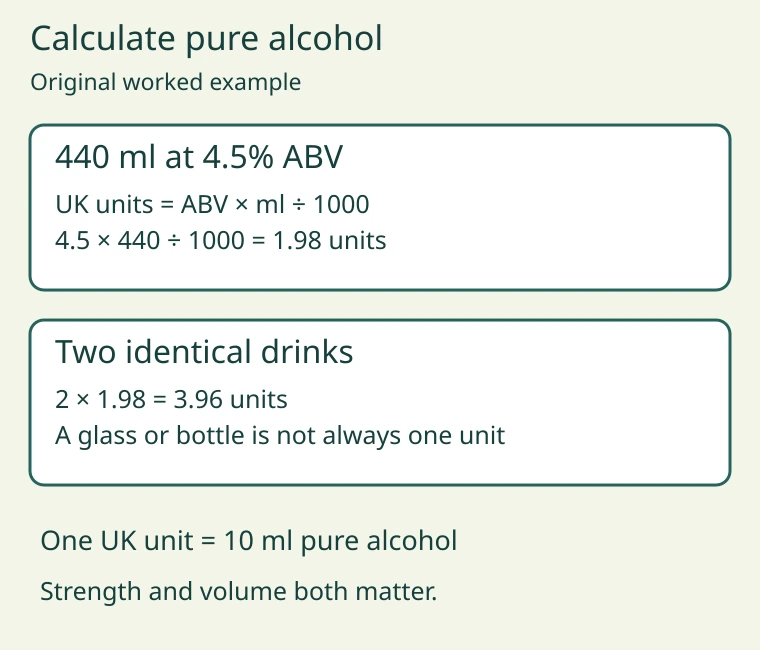
ABV is a concentration by volume. One UK unit is 10 ml, or approximately 8 g, of pure alcohol. To calculate units, multiply the ABV number by the volume in millilitres and divide by 1000. If using litres, multiply the ABV number directly by litres. The percentage does not tell you the number of units until the serving volume is known.
Worked example: a 440 ml drink at 4.5% contains 4.5 × 440 ÷ 1000 = 1.98 units. Two contain 3.96 units. A 175 ml glass at 12% contains 2.1 units, so counting each glass as one unit would understate the alcohol. To find pure alcohol volume instead, multiply the whole volume by the percentage as a decimal: 175 × 0.12 = 21 ml.
The UK low-risk guideline is not to drink regularly more than 14 units per week for men or women. If drinking up to that amount, spread it over three or more days; several alcohol-free days can help reduce intake. This is not a daily allowance, a guarantee of no harm, a driving limit or permission to save a week's alcohol for one session. During pregnancy or when planning pregnancy, the safest approach is not to drink.
Alcohol can impair judgement, coordination and self-control, contributing to accidents and conflict. A person feeling confident is not necessarily making sound decisions. Repeated heavy drinking can harm the liver, heart and brain and increase risks of several cancers and mental-health problems. Beer and wine do not avoid these effects because they are not spirits. These health facts support responsible service; they do not provide an individual medical assessment or a formula for safe driving.
Sources: Licensing Act 2003, section 191, DHSC: Low Alcohol Descriptors Guidance (2018), NHS: calculating alcohol units, NHS: risks of drinking too much.
Applying for, changing and reviewing a premises licence
The four licensable activity categories are retail sale of alcohol, supply of alcohol by or on behalf of a qualifying club to or to the order of a member, regulated entertainment, and late-night refreshment. Each has definitions and exemptions. Late-night refreshment generally involves hot food or hot drink supplied to the public between 23:00 and 05:00; not every food sale is therefore licensable.
A normal premises application includes its form and fee, operating schedule, a clear premises plan and, for alcohol sales, consent from the proposed DPS. Relevant individual applicants also supply work-entitlement evidence. Follow the required advertising and responsible-authority process. Relevant representations concern the licensing objectives: a resident's evidence about expected noise can be relevant, while simple dislike of the cuisine is not. If no relevant representations are made, the statutory grant follows with conditions consistent with the operating schedule and mandatory conditions; it is not permission for any activity at any time.
After grant, check permission before changing the operation. A minor variation is for changes that cannot adversely affect the objectives within that route's restrictions. Adding alcohol sales, increasing the amount of alcohol-sale time on a day, or extending alcohol hours into 23:00–07:00 requires the full variation route. Some changes that reduce hours or move them without increasing time within the permitted daytime window can be minor. Do not assume a physical change is minor merely because it looks small.
A review addresses objective-related problems linked to particular premises. Responsible authorities or other persons can seek it on the applicable grounds. The authority may modify conditions, exclude activities, remove the DPS, suspend the premises licence for up to three months, or revoke it. These are licensing measures, not a criminal court imposing imprisonment. Evidence and proportionate action matter; simply replacing one DPS repeatedly may fail to address a business-wide management problem.
Section 136 makes unauthorised licensable activity, or activity outside its authorisation, an offence. Its maximum is up to six months' imprisonment, an unlimited fine or both. Old £20,000 summaries should not be carried into a current answer. For the applicable section 139 defence, a specified cause such as a mistake or another person's act must be accompanied by all reasonable precautions and due diligence. A staff mistake alone, a paid licence fee or a promise to improve does not establish that defence.
Sources: Licensing Act 2003, section 1, Home Office section 182 guidance (November 2026), Licensing Act 2003, section 136, Licensing Act 2003, section 139.
Mandatory conditions and the DPS
Ordinary premises licensed to sell alcohol must have a DPS who holds a valid personal licence, and every alcohol sale must be made or authorised by a personal licence holder. The DPS is the identified day-to-day management contact, but need not personally serve or witness every sale. The premises licence holder retains responsibilities too. Written staff authorisation is strongly recommended evidence of who may do what; the legislation does not require a newly signed authorisation for every individual drink.
Qualifying community premises can apply for the alternative condition under which the management committee makes or authorises alcohol supplies. This must be formally approved; it is not an assumption that every village hall is automatically free of DPS requirements. TENs and club certificates also have their own rules, so do not apply every ordinary premises-licence condition identically to every authorisation.
For the relevant on-sales premises, mandatory conditions prohibit irresponsible promotions, including rapid-drinking games and unlimited fixed-price offers that create a significant risk to the objectives. They also prohibit direct dispensing into another person's mouth except to assist a person with a disability. Not every discount is automatically prohibited: identify the actual practice and the condition's risk test.
Free potable water must be available on request where reasonably available. Non-presealed drinks must offer the required small measures: half a pint for beer or cider, 25 ml or 35 ml for gin, rum, vodka or whisky, and 125 ml for still wine. Make the availability clear and tell customers where they have not specified a quantity. Selling larger sizes does not replace these small-measure duties.
Age verification applies to on- and off-sales and needs a policy followed in practice. Film exhibitions have mandatory child-admission classification conditions; the relevant BBFC or licensing-authority classification cannot be replaced by a staff preference. Where the licence requires licensable door-supervision security activity, the appropriate SIA licence is a separate requirement: an APLH qualification or personal licence is not a security licence.
Sources: Licensing Act 2003, section 19, Home Office section 182 guidance (November 2026).
Price floors: separate Wales from the general condition
The permitted-price mandatory condition uses alcohol duty plus the VAT attributable to that duty. It is not a rule that every drink must exceed wholesale purchase cost or have a fixed profit margin. The current applicable duty and VAT calculation must be used for the actual product.
Wales also has minimum unit pricing. From 1 October 2026 the minimum is £0.65 per unit, replacing £0.50. Calculate units from the product's strength and volume, multiply by £0.65, then apply the final monetary rounding rule. Do not round away units early. The 65p figure is not an England-wide minimum unit price.
Worked example: a Welsh sale of a 1.5 litre drink at 6% contains 6 × 1.5 = 9 units. Its minimum price is 9 × £0.65 = £5.85. For a 330 ml drink at 5%, the calculation is 1.65 × £0.65 = £1.0725, rounded to £1.07. A final exact half-penny rounds upwards. This is a legal floor calculation, not advice about the amount someone should drink.
Sources: Home Office section 182 guidance (November 2026), Welsh Government: minimum unit pricing (2026).
Temporary events: count people, days and notices separately
A TEN is a notice given by an individual aged at least 18, called the premises user. The user need not hold a personal licence, but that status changes their annual limits. A compliant notice permits the notified temporary activities subject to the statutory process; it is not an ordinary application that needs a discretionary grant in every case. Other laws and alcohol offences continue to apply.
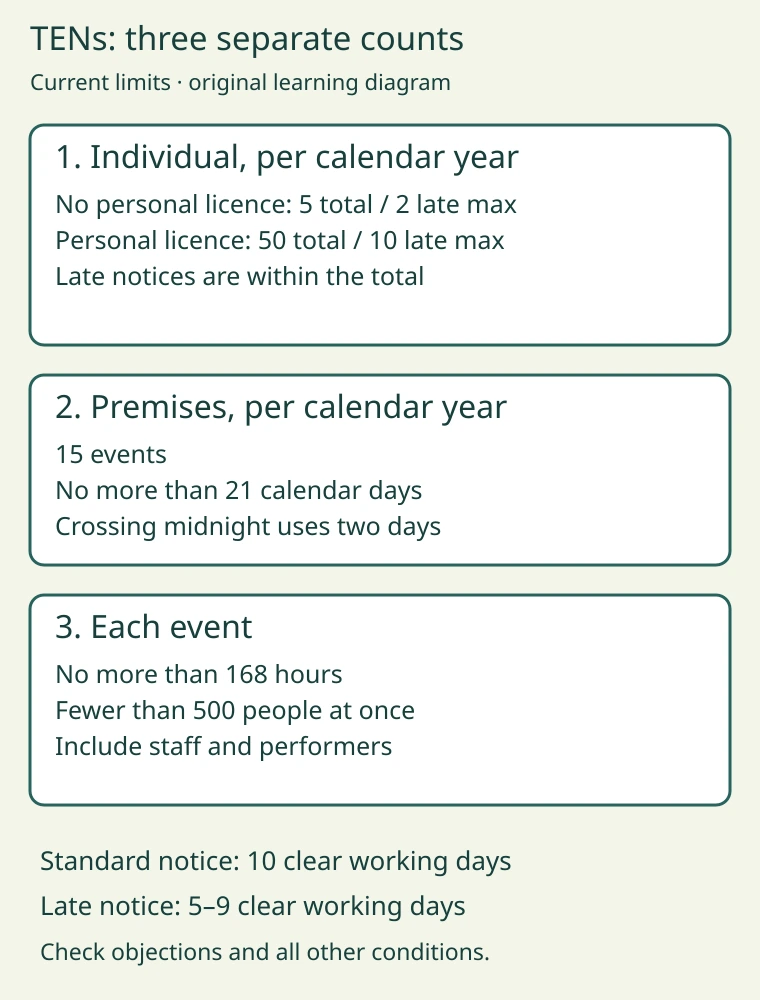
A standard TEN needs at least ten clear working days before the event. A late TEN is given five to nine clear working days beforehand. Exclude the day of receipt and the event day, weekends and bank holidays. Send the required copies to police and environmental health unless using the electronic process under which the authority forwards them. These are working-day submission rules; do not confuse them with the calendar days an event occupies.
A non-personal-licence holder may give five TENs per calendar year, including no more than two late notices. A personal licence holder may give fifty, including no more than ten late notices. The late allowance is inside the total, not extra. Separately, a premises may host fifteen TEN events occupying no more than twenty-one days in the calendar year. Each event may last no more than 168 hours and must have fewer than 500 people present at once. Count staff and performers as well as customers.
Worked example: an event from 18:00 on Friday to 02:00 on Saturday lasts eight hours but uses two calendar days. Another event with 480 customers, ten staff and eight performers has 498 people, within the numerical cap; adding three more staff would take it over. A same-user or associate event at the same premises normally needs at least a 24-hour gap. Splitting notices between associates is not a way around the limits.
Police or environmental health may object on any of the four objectives, normally within three working days of receipt. A standard notice can go through the hearing process; an objection to a late notice prevents it proceeding without that hearing route. A personal licence does not override an objection. Withdraw a notice at least 24 hours before the event if relying on the rule that avoids counting it toward the annual limits; merely not holding the event is not the same as proper withdrawal.
Sources: Home Office section 182 guidance (November 2026).
Drunkenness, disorder, drugs and staff action
Do not knowingly sell or attempt to sell alcohol to a person who is drunk, or knowingly allow the sale. A sober friend paying does not solve the problem: knowingly obtaining alcohol for a drunk person to consume on the premises is also an offence. Politeness, a weaker drink or an expensive order does not change the legal issue. Apply the refusal procedure and support the staff member making the decision.
Use calm communication, maintain safe space, seek trained assistance and manage the situation under the venue's procedures. Train staff before an incident, not only afterwards. Refusal and incident records, shift handovers and appropriate local partnership information help the next team understand what happened. Records are evidence of action, not a guarantee of legal immunity or a substitute for immediate safety measures.
Section 140 can apply to a person authorised by their work role to prevent disorder, as well as the specified holders and supervisors, who knowingly allows it. The maximum fine is level 3, £1,000; the sale-to-a-drunk and buying-for-a-drunk offences also have level-3 maxima. A drunk or disorderly person who without reasonable excuse refuses an authorised request to leave, or improperly tries to re-enter, faces the separate section 143 level-1 maximum of £200. The police can assist with expulsion in the statutory circumstances.
Knowingly permitting illegal drug supply can be a criminal offence under section 8 of the Misuse of Drugs Act. That section also specifies other activities, including unlawful production and smoking cannabis or prepared opium; it should not be paraphrased as though every possible use of every drug has identical wording. Drug-related crime can also support licensing review on the crime-and-disorder objective. A manager need not personally sell the drug for knowingly permitting dealing to be serious.
Sources: Licensing Act 2003, section 140, Licensing Act 2003, section 141, Licensing Act 2003, section 142, Licensing Act 2003, section 143, Misuse of Drugs Act 1971, section 8, Home Office section 182 guidance (November 2026), Sentencing Act 2020, standard scale.
Protecting children: purchase, consumption and presence
The legal purchase age is 18. An under-18 cannot buy alcohol merely because a parent agrees or because a meal is served. A person under 18 also commits the relevant purchase/attempt offence, subject to the authorised police or trading-standards test-purchase exception. That exception does not make the seller's underage sale lawful.
The limited table-meal exception is precise: an adult can buy beer, wine or cider for a 16- or 17-year-old to consume at a table meal on relevant premises while accompanied by an adult. It is not permission for the young person to buy, for spirits to be served, for a 15-year-old to drink, or for takeaway alcohol. Worked example: an adult buys cider for an accompanied 17-year-old with the meal; the specified exception can apply. Changing cider to vodka removes that exception even though the age and adult remain unchanged.
Young employees have a different rule. At an ordinary bar, an under-18's sale needs specific approval by a responsible person under section 153. That includes the holder, DPS or an adult authorised for that purpose; a parent or customer is not automatically a responsible person. A limited table-meal-service exception has its own conditions about the premises or relevant part being used for those meals. Do not convert that exception into a blanket approval for all young bar staff.
Presence is separate from purchase. While premises exclusively or primarily used for alcohol on-sales are open for supplying alcohol for consumption there, under-16s must not be allowed unaccompanied, subject to the statutory exceptions. At other relevant alcohol premises, the unaccompanied under-16 restriction applies between midnight and 05:00 while they are open for that supply. Accompanied means with someone aged 18 or over. Check any additional premises conditions; a soft-drink order is not itself a waiver.
Child protection is broader than alcohol age checks: safeguarding against exploitation, suitable entertainment and relevant child-performance or other legal requirements remain important. Film classifications and any applicable admission conditions need attention even when no child is buying alcohol.
A concrete separate law is section 37 of the Children and Young Persons Act 1963. It regulates child performances, including performances at premises authorised to supply alcohol and those involving an admission charge. The child-performance licence is separate from the venue's alcohol or entertainment permission. Section 37(3) includes an exception where no payment beyond expenses is made to the child or anyone else for taking part and the child has performed on no more than three other qualifying days in the preceding six months. It also contains school-arranged and approved-body alternatives, again subject to the no-payment condition. Do not reduce this to a universal exemption for a first performance.
For example, a 14-year-old is paid a performance fee for a first public concert at a licensed venue. The fee prevents reliance on the no-payment exemptions; parental consent and the premises licence do not replace the separate child-performance licence. The organiser should apply to the child's home local authority. GOV.UK also explains appropriate supervision: without a parent, school teacher or home tutor, the child needs a council-approved chaperone. Confirm the applicable performance and education arrangements with the authority; an exemption from individual performance licensing does not remove all safeguarding obligations.
Penalties depend on the offence and person. An adult's unlawful underage sale under section 146 can attract an unlimited fine; the old £5,000 maximum is obsolete. The under-18 purchaser's own offence has a level-3 maximum of £1,000. Knowingly allowing a young worker's sale without required approval under section 153 has a level-1 maximum of £200. Do not learn one figure labelled “children and alcohol” and apply it everywhere.
Sources: Licensing Act 2003, section 145, Licensing Act 2003, section 146, Licensing Act 2003, section 149, Licensing Act 2003, section 150, Licensing Act 2003, section 153, Home Office: licensing fine changes (2015), Home Office section 182 guidance (November 2026), Sentencing Act 2020, standard scale, Children and Young Persons Act 1963, section 37, GOV.UK: performance licences and supervision for children.
Age verification after the 2026 digital-proof change
For physical proof under the mandatory age-verification condition, look for a photograph, date of birth, and a holographic mark or ultraviolet feature. Check the document belongs to the person and appears valid. A PASS-accredited proof-of-age card can be useful, but the rule is not that only one named card is acceptable. A student card without the required features or a typed birth date is not equivalent evidence.
The current guidance also permits qualifying digital verification following the September 2026 change. The process must use a certified and registered digital verification service under the required arrangements and meet at least the specified medium confidence level. Looking at a passport screenshot, a photograph of an app or a customer's typed date of birth is not that verified process. Facial age estimation alone is not the same as this proof-of-age route.
Digital acceptance is optional for the business. Physical proof remains available, and an existing licence condition that restricts the accepted proof may need variation before the business adopts a conflicting digital process. Staff need training in the actual system, including matching the result to the person and handling only the necessary information.
Challenge 21 or Challenge 25 is a policy about when to request proof; it does not raise the statutory purchase age above 18 or permit sale to someone younger who looks older. For remote or delivery sales, plan age verification through to handover. A tick-box at ordering is not a substitute for a system that prevents underage supply.
Sources: Home Office section 182 guidance (November 2026).
Closure and entry powers: identify the legal route
Closure of one identified premises and closure across a geographical disorder area are different powers. Under the current Anti-social Behaviour, Crime and Policing Act provisions, a closure notice can be issued by police at least inspector rank, the local authority, or an eligible registered social housing provider for premises it owns or manages, subject to the statutory conditions. The ordinary notice limit is now 48 hours; the required senior authorisation can permit up to 72 hours. These current figures differ from older 24/48-hour notes.
A notice cannot prohibit the owner or habitual residents from access. A court closure order can have wider effect under its own conditions. Section 80 requires the magistrates' court hearing normally within 48 hours of service of the notice, with the statutory Christmas-day counting provision. The initial court order can last up to three months; extensions cannot make the total exceed six months. A longer notice period is not an automatic longer court-hearing deadline. Use the operative statute if a summary graphic gives a conflicting period.
For disorder or expected disorder in a geographical area, Licensing Act section 160 allows a magistrates' court, on an application by police superintendent rank or above, to close the relevant premises for up to 24 hours. This is not the same as the identified-premises ASB notice and order process. Identify the actor, the reason, the legal power and the duration before selecting a number.
Under section 179, a constable or authorised person with reason to believe licensable activity is being or is about to be carried on can enter to check authorisation and compliance. An authorised officer must show evidence of authority if asked. Immigration officers have their own specified power concerning relevant licensable activities and immigration offences. These powers have statutory boundaries; they are not equivalent to any visitor demanding access. Intentional obstruction of lawful exercise of the power is different from asking an authorised officer to identify their authority.
Sources: ASB Act 2014, section 76, ASB Act 2014, section 77, ASB Act 2014, section 80, ASB Act 2014, section 82, Licensing Act 2003, section 160, Licensing Act 2003, section 179.
Retail exclusions, entertainment exemptions and transport
A trade sale is not excluded from retail merely because a large quantity changes hands. Section 192 requires the appropriate buyer and trade purpose, qualifying ownership or lease of the seller's premises, and consumption off those premises. An employee buying for the employer's licensed resale can be in a different position from the same employee buying for a private party. A staff badge or personal licence does not make every personal purchase wholesale.
Regulated entertainment includes plays, films, indoor sport, boxing or wrestling, live and recorded music, dance and relevant similar entertainment, within the Act's definitions. Exemptions then narrow what needs authorisation. Live simultaneous radio or television broadcasts, genuinely incidental music and specified private non-profit circumstances are examples, but an exemption for one activity does not authorise alcohol sales or settle copyright obligations.
Unamplified live music between 08:00 and 23:00 has a broad exemption. Qualifying amplified live or recorded music at alcohol on-sales premises during the relevant operation can be exempt for an audience up to 500 in that window, subject to the specific rules and any review-reinstated conditions. Plays and dance have a 500-audience exemption in the same window; ordinary indoor sport has a 1,000-person limit. Ordinary boxing is not simply treated as that indoor sport. A qualifying not-for-profit community film screening also needs the relevant consent and compliance with age classifications. Check the complete exemption rather than borrowing a number from another activity.
Other laws still apply when entertainment permission is unnecessary: safety, noise, child protection and relevant performance rules do not disappear. An event extending beyond an exemption's hours or growing beyond its applicable limit may need authorisation for the affected activity. Planning around the exemption requires realistic control of times and numbers.
Alcohol sales are prohibited at the statutory motorway-service premises and at premises used primarily as a garage within the definition. A mixed petrol/shop site's primary use needs assessment; a car park or some vehicle accessories do not alone decide it. Road vehicles cannot sell alcohol while moving under section 156. A parked mobile bar needs appropriate permission for the relevant location; a personal licence does not cover every stop automatically.
Transport exceptions include the relevant aircraft or train journey circumstances, while a permanently parked carriage used as a restaurant is not exempt simply because it was once a train. Boats and designated airport or port areas have specific provisions and must be checked on their actual facts. The general lesson is to read the activity, location and statutory conditions together, rather than deciding from the object's name.
Sources: Licensing Act 2003, section 192, Home Office section 182 guidance (November 2026), Licensing Act 2003, section 156, Licensing Act 2003, section 176.
A preparation sequence and how to use the study test
Start with the three permissions and four objectives. Then work through personal-licence application and continuing duties, separating the applicant, holder, court and authority. Continue to premises conditions and the DPS, then TEN counting and deadlines. Study child protection, refusal and disorder together because a real service decision can involve more than one rule. Finish by distinguishing closure routes and the scope of exemptions.
Use short written explanations as a check: explain why a personal licence does not extend premises hours; why a 16/17 meal exception does not allow a young person to buy; and why fifty personal-holder TENs do not allow fifty events at one premises. For arithmetic, write the units formula and calculate before looking at a choice. When the answer changes between England and Wales or between an old and current source, write the jurisdiction and date beside it.
The BIIAB APLH study test contains 146 questions: 139 single-answer choices and seven numerical entries. It presents the whole bank in shuffled order, without a timer or pass threshold. The numerical entries are added learning exercises, not a claim that the official multiple-choice paper uses numerical input. Enter only the number in the requested units; read the explanation even after a correct guess. Each explanation names the relevant public assessment criterion and source.
Return to the source and theory for an error, then retry the reasoning with a changed fact. Before the real assessment, confirm the current qualification guide and centre instructions and practise the official 40-question, 60-minute time allocation with appropriate authorised materials. Our score does not award a licence or certify readiness for every workplace situation.
For further reading, use the BIIAB guide for coverage and assessment rules; the current Licensing Act and Home Office section 182 guidance for licensing procedures and conditions; the ASB Act for current closure powers; Welsh Government guidance for minimum pricing; and NHS guidance for units and health. Source checks for this article were made on 28 November 2026. Current local licence conditions and later amendments remain relevant to actual operation.
Sources: BIIAB qualification guide v2.3 (May 2026), Home Office section 182 guidance (November 2026), NHS: calculating alcohol units, Welsh Government: minimum unit pricing (2026).