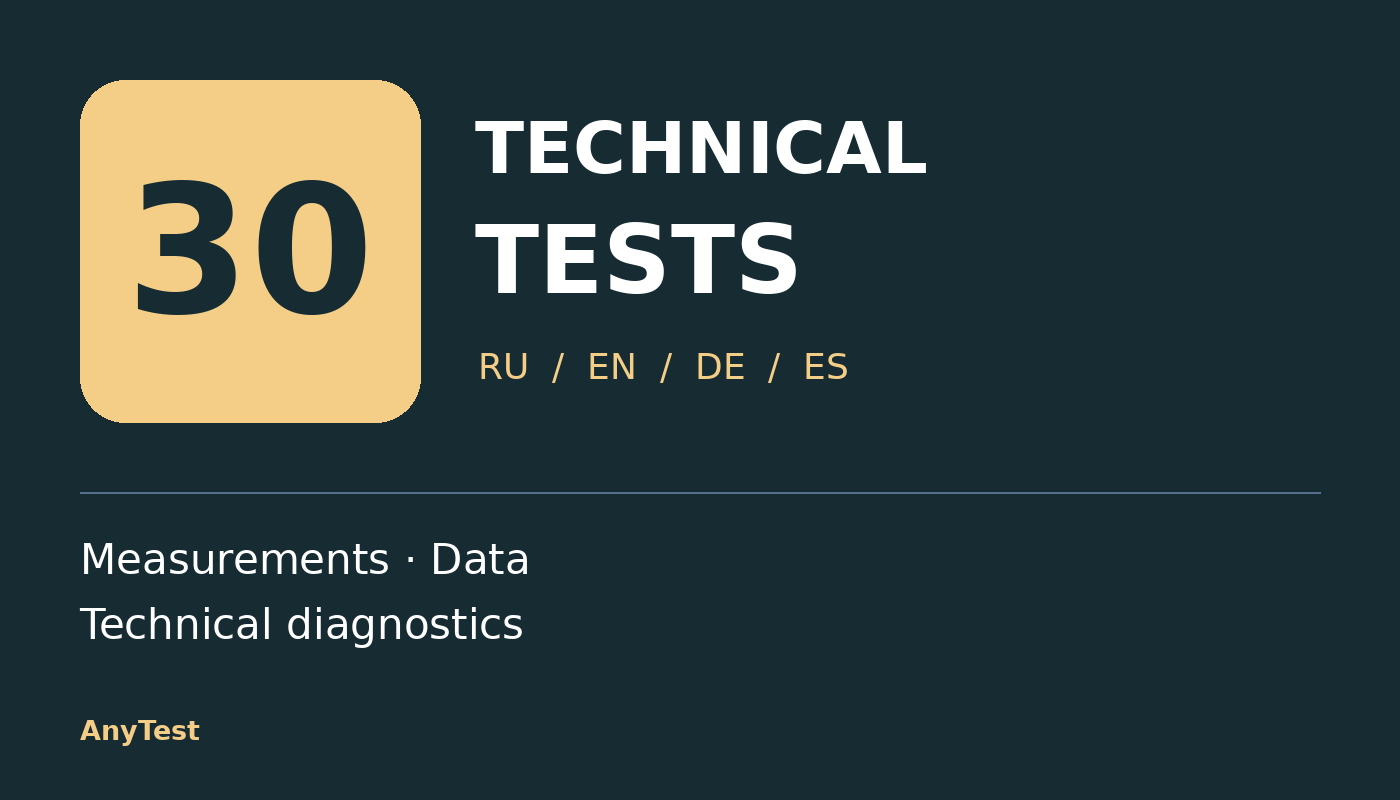
A temperature reading changes after rewiring, an array operation loses rows, or a print preview hides an object: these tests ask you to trace the result back to its cause. The new collection contains 30 distinct topics and 854 questions with explanations: 10 tests in Russian, 10 in English, 5 in German and 5 in Spanish.
Choose a topic and read its scope before starting. Each attempt includes the whole question bank in a shuffled order, with one correct answer out of four and no time limit. The learning target is 80%, rounded up to a whole number of correct answers; the exact threshold appears in the instructions.
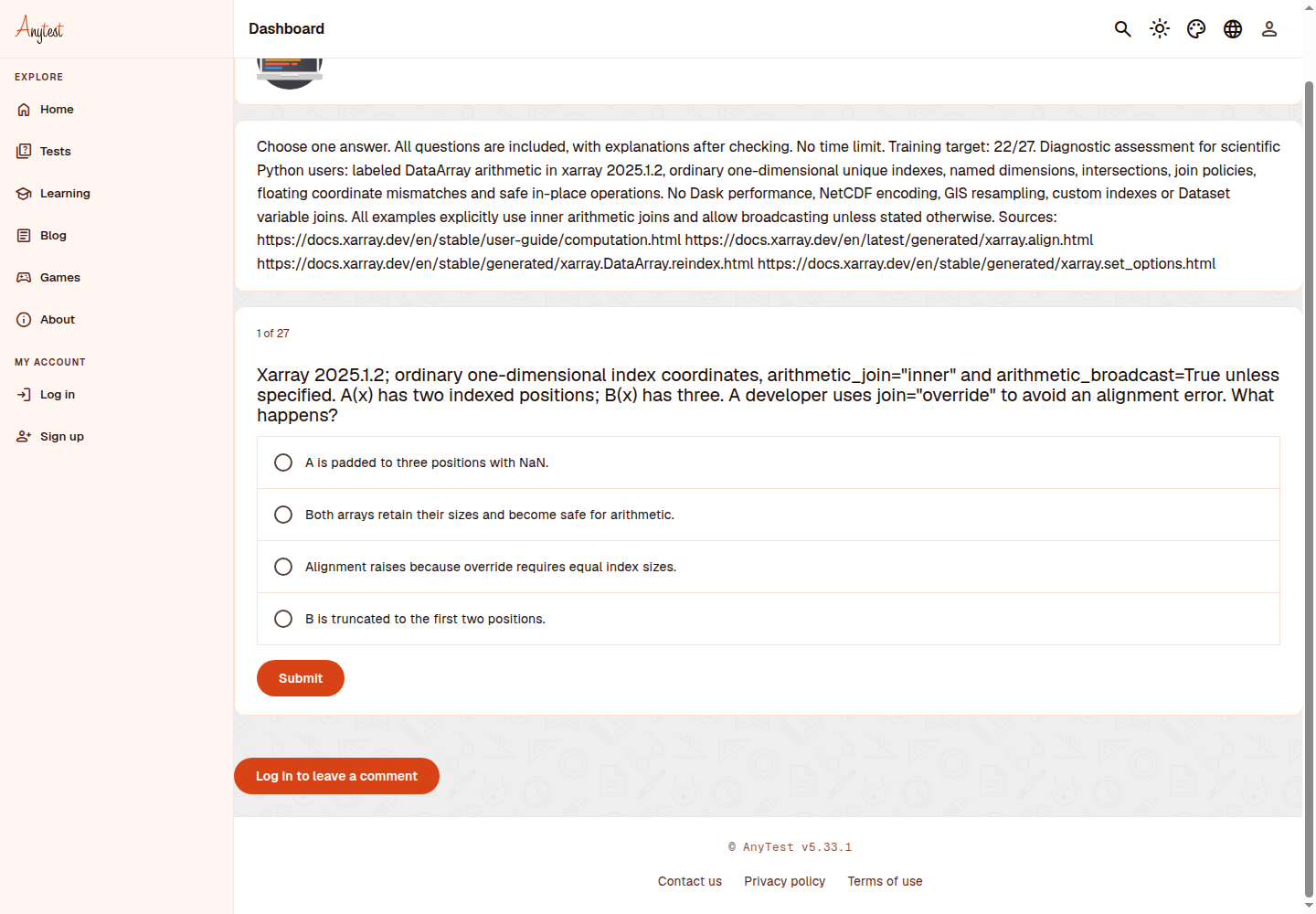
A question from a real local attempt. Read the given data before choosing an answer.
In Russian: measurement and laboratory data
Investigate sensor wiring, calibration, observation quality and the limits of laboratory measurements. Each test states the conditions needed to interpret the data.
- Метод БЭТ: расчёт удельной поверхности и проверка пригодности данных — 27 questions
- Кондуктометрия: постоянная ячейки, температура и причины расхождения результатов — 28 questions
- ДСК полимеров: первый и второй нагрев, энтальпия и тепловая история — 28 questions
- Лазерная дифракция: распределение частиц и ошибки подготовки пробы — 28 questions
- Нивелирный ход: контроль наблюдений и взвешенное распределение невязки — 26 questions
- pH-электрод: наклон калибровки, температурная компенсация и дрейф — 26 questions
- Дозирование сложных жидкостей: выбор техники и диагностика ошибок — 28 questions
- Pt100: диагностика проводов, компенсации и самонагрева — 28 questions
- Тензометрия: мостовые схемы, температурный дрейф и проверка канала — 28 questions
- Термопары: холодный спай, полярность и диагностика измерительного тракта — 26 questions
In English: data pipelines and reproducible results
Follow coordinate labels, packed values, chunk boundaries, workflow dependencies and asynchronous execution. Diagnose results from concrete data and logs.
- Dask Arrays: Chunk Layout and Memory Diagnostics — 30 questions
- Git Attributes: Diagnose Line Endings, Index State and Renormalization — 30 questions
- Git Bisect: Reliable Automated Regression Searches — 30 questions
- GitHub Actions: Matrix Expansion, Failure Policies and Result Fan-In — 31 questions
- NetCDF: Packed Values, Masks and Metadata Errors — 30 questions
- Nextflow DSL2: Keyed Channels and Missing Results — 28 questions
- Parquet: Diagnose Row-Group Statistics and Pruning — 32 questions
- Python 3.13 asyncio: Cancellation, Timeouts and Task Groups — 30 questions
- Snakemake: Wildcards, Targets and DAG Diagnosis — 30 questions
- Xarray: Coordinate Alignment and Silent Data Loss — 27 questions
In German: geometry, print and simulation
Check how geometry becomes a mesh, which printing plates receive colour, and what simulation or bibliography logs actually prove. Different tests cover different tools and failure modes.
- biblatex und Biber: Literaturverzeichnisse systematisch diagnostizieren — 31 questions
- Blender: Bevel-Fehler durch Skalierung, Topologie und Normalen erkennen — 26 questions
- FreeCAD: STL-Tessellierung und Exportfehler diagnostizieren — 30 questions
- InDesign und Acrobat: Überdruckfehler und Farbseparationen diagnostizieren — 26 questions
- LTspice: Konvergenzfehler, Arbeitspunkt und Zeitschritte diagnostizieren — 30 questions
In Spanish: image, drawing and audio diagnostics
Reason about paths, masks, projected dimensions and audio timing. Text scenarios state the relevant observations; they do not claim to measure listening or visual-editing skill directly.
- Audacity: diagnóstico de reducción de ruido y conservación de la voz — 28 questions
- FreeCAD TechDraw: diagnosticar cotas, proyecciones y escalas — 28 questions
- GIMP 3.0: diagnóstico de máscaras de capa y transparencia — 28 questions
- Inkscape: diagnóstico de trayectos, trazos y operaciones booleanas — 28 questions
- OBS Studio: desfase, deriva y rutas de audio — 28 questions
Use the explanations to check your reasoning
After finishing, open the answer review. It shows your choice, the correct answer and an explanation. Revisit a missed question and compare the reasoning with the assumptions in its prompt.
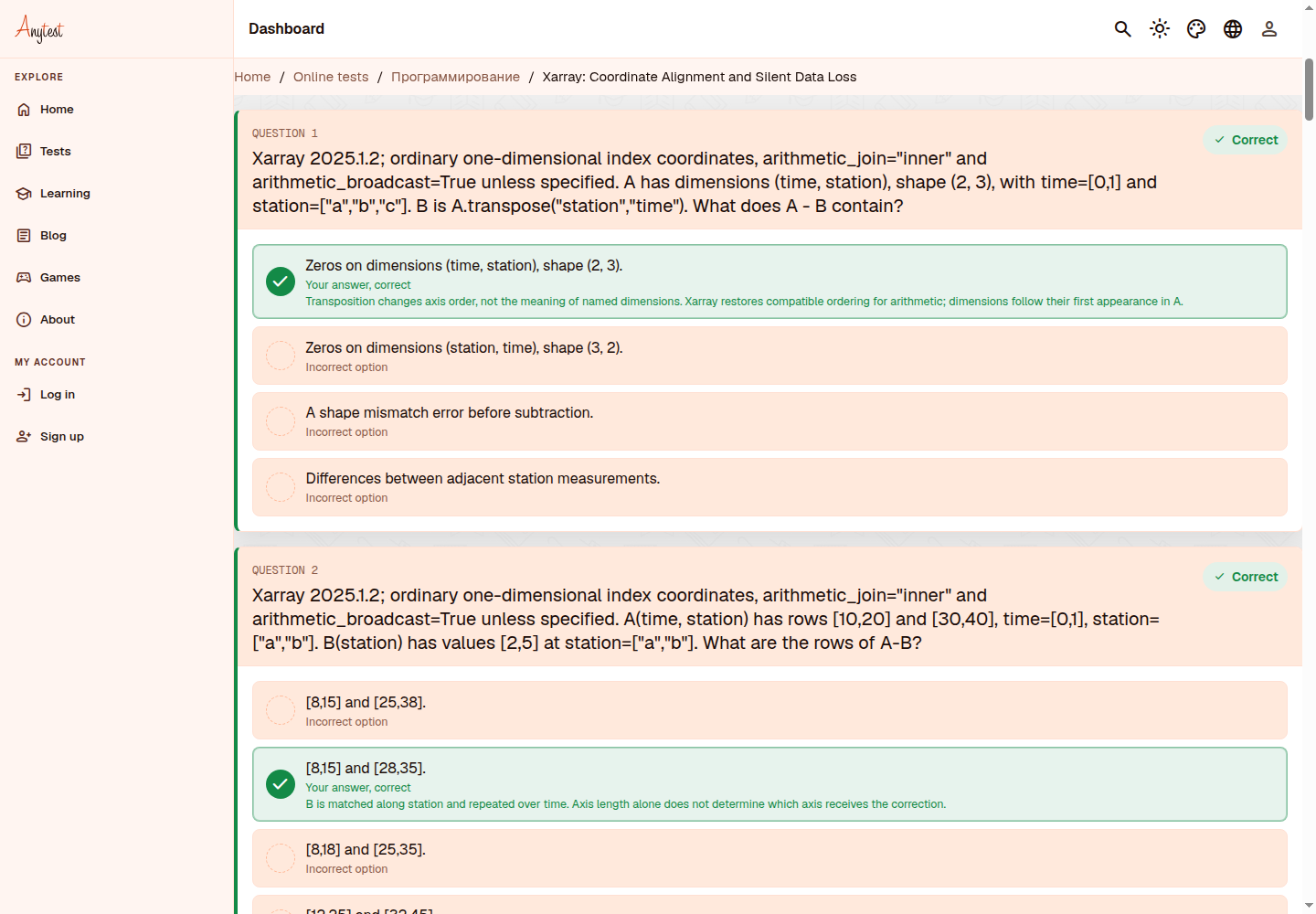
Answer review after a real local attempt.
These are original tests on specific topics, not official certification exams or substitutes for a full course. The language groups cover different topics rather than translations of one bank. Sources and scope limits are listed in each test.