A shifted map layer, an unexpected spectrum peak, a schema change that breaks a reader: these tests ask you to trace a result back to its cause. The new collection contains 30 distinct topics and 845 questions with explanations: 6 tests in Russian, 14 in English, 6 in German and 4 in Spanish.
Choose a topic and read its scope before starting. Each attempt includes the whole question bank in a shuffled order, with one correct answer out of four and no time limit. The learning target is 80%, rounded up to a whole number of correct answers; the exact threshold appears in the instructions.
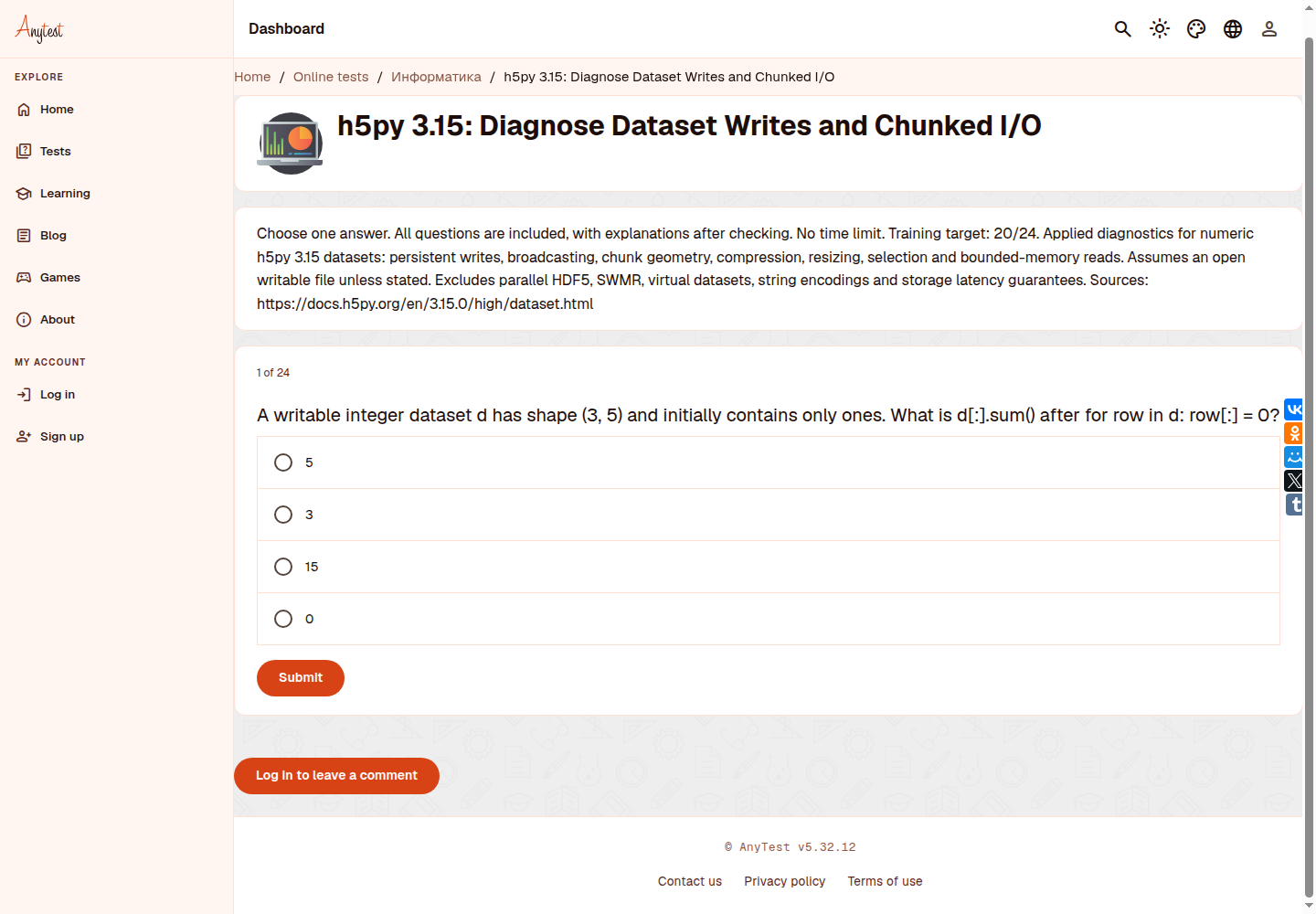
A question from a real local attempt. Read the given data before choosing an answer.
In Russian: numerical methods and coordinate errors
Check FFT scaling, differential-equation events, numerical integration and nonlinear fitting. The QGIS tests distinguish coordinate-system mistakes from the separate problem of evaluating a georeferenced image.
- FFT в NumPy и SciPy: диагностика частот, амплитуд и PSD — 32 questions
- QGIS: диагностика смещения слоёв и ошибок систем координат — 26 questions
- QGIS: контроль качества геопривязки сканов и снимков — 28 questions
- SciPy solve_ivp: события, точность и диагностика решения ОДУ — 28 questions
- SciPy curve_fit и least_squares: диагностика подгонки параметров — 28 questions
- SciPy integrate: диагностика численных интегралов — 28 questions
In English: data, schemas and build tools
Work through raster and spatial-join errors, interpolation and sparse solvers, then investigate schema evolution, HDF5 writes, build dependencies, tracing, file transfers and Python wheel compatibility. Each test states its own assumptions and scope.
- Avro 1.12: Writer–Reader Schema Resolution — 30 questions
- CMake 3.31: Target Usage Requirements and Dependency Graphs — 26 questions
- GNU make: Expansion Timing and Prerequisite Diagnostics — 30 questions
- h5py 3.15: Diagnose Dataset Writes and Chunked I/O — 24 questions
- JSON Schema 2020-12: Composition and Closed-Object Debugging — 28 questions
- OpenTelemetry: Diagnose Broken Trace Context Propagation — 30 questions
- Protobuf: Binary and ProtoJSON Schema Evolution — 30 questions
- Python Wheels: Diagnose Platform and ABI Compatibility — 32 questions
- QGIS and GDAL Raster Analysis: NoData, Grid Alignment and Resampling — 28 questions
- QGIS 3.44 Spatial Joins: Boundaries, Multiple Matches and Summaries — 28 questions
- rsync: Audit Transfer Filters and Deletion Outcomes — 26 questions
- SciPy Multidimensional Interpolation: Grids, Gaps and Extrapolation — 30 questions
- SciPy Sparse Solvers: Singularity, Convergence and Residuals — 28 questions
- systemd: Diagnose Unit Dependency and Ordering Failures — 34 questions
In German: design tools and system behaviour
Diagnose FreeCAD sketch constraints and KiCad design-rule reports, read POSIX ACL masks, and reason about MQTT sessions and TCP captures. The CODESYS test follows instance state through explicitly ordered calls.
- CODESYS ST: Instanzzustand, Aufrufreihenfolge und Flankenerkennung — 25 questions
- FreeCAD Sketcher: Freiheitsgrade und Randbedingungen diagnostizieren — 30 questions
- KiCad 9: Netze, Kupferverbindungen und DRC-Fehler diagnostizieren — 34 questions
- Linux-POSIX-ACLs: effektive Rechte, Masken und Vererbung — 26 questions
- MQTT 3.1.1: Wiederverbindungen und doppelte Zustellungen diagnostizieren — 18 questions
- Wireshark: TCP-Wiederholungen und Grenzen des Mitschnitts — 29 questions
In Spanish: timing, media and data operations
Trace Arduino timer rollover, FFmpeg concatenation failures, pandas merge contracts and R factor recoding. The questions use concrete values and conditions so you can check the reasoning behind each result.
- Arduino: diagnosticar millis(), desbordamientos y temporizadores — 27 questions
- FFmpeg: diagnóstico de concatenación, flujos y marcas de tiempo — 32 questions
- pandas merge: claves, nulos y contratos de unión — 23 questions
- R: factores, niveles y recodificación sin alterar los datos — 27 questions
Use the explanations to check your reasoning
After finishing, open the answer review. It shows your choice, the correct answer and an explanation. Revisit a missed question and compare the reasoning with the assumptions in its prompt.
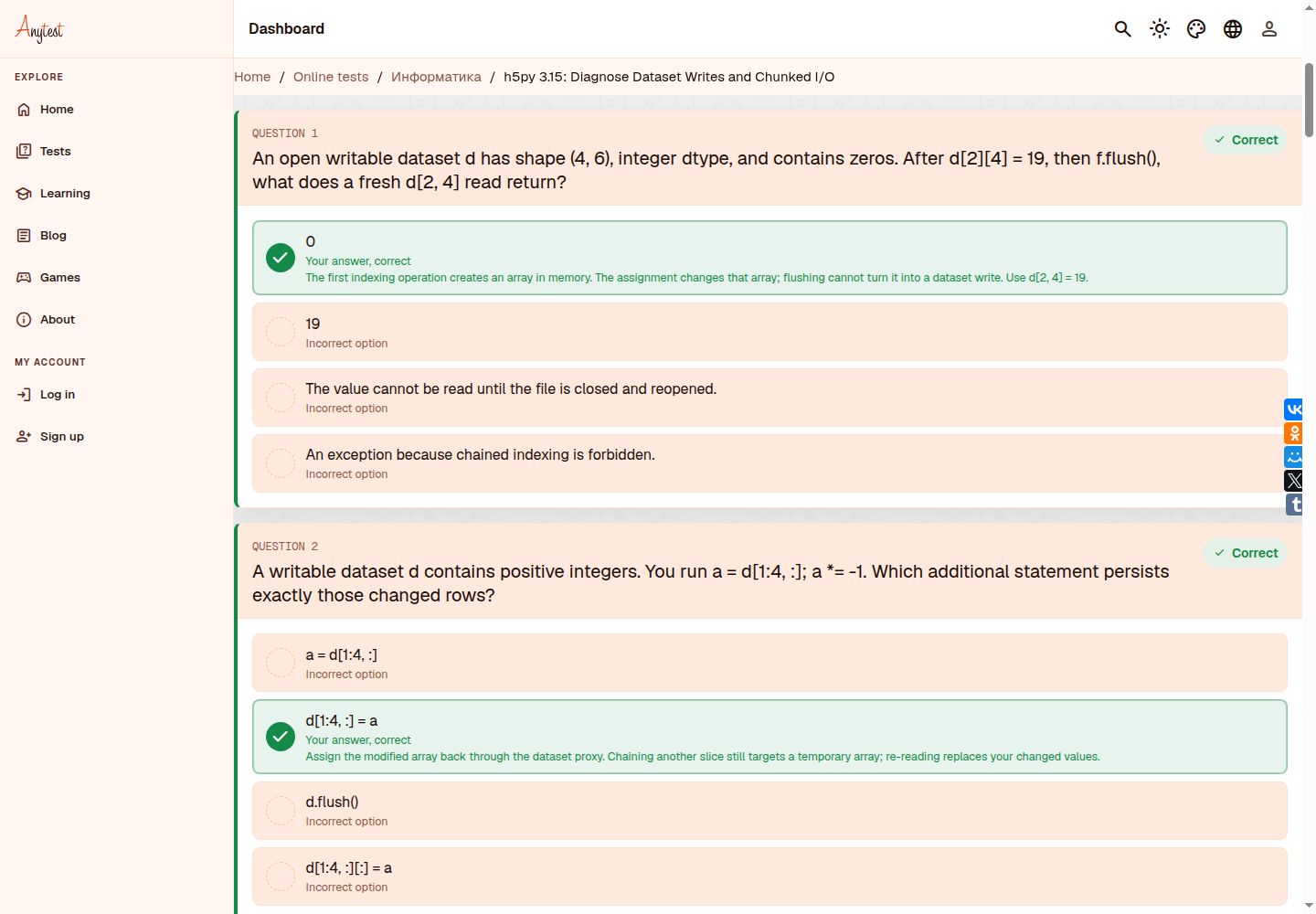
Answer review after a real local attempt.
These are original tests on specific topics, not official certification exams or substitutes for a full course. The language groups cover different topics rather than translations of one bank. Sources and scope limits are listed in each test.