EPA Section 608 Universal preparation becomes easier when three questions stay separate: what the refrigerant does, what the equipment can safely do, and what the current rule requires. This guide connects the Core, Type I, Type II and Type III topics with original examples. Source check: November 28, 2026. The accompanying questions are independent learning material, not the confidential EPA examination pool.
1. What Universal certification covers
Section 608 technician certification concerns work that can release refrigerant from covered appliances. Type I covers service of small appliances. Under the current regulatory wording, Type II covers medium-, high- and very high-pressure appliances, with the stated exceptions. Type III covers low-pressure appliances. Universal combines the three technical areas with Core knowledge. Paid servicing of motor-vehicle air conditioners has separate Section 609 requirements; “Universal” does not erase that boundary. The rules also distinguish service from disposal: disposal of small appliances, MVACs and MVAC-like appliances has a certification exemption, while recovery obligations still apply. See 40 CFR 82.161.
The official Universal examination contains 100 questions: 25 Core and 25 from each technical group. It is closed-book and proctored through an EPA-approved certifying program. Appendix D specifies a 70% passing standard; with 25 questions this requires at least 18 correct in a section. Confirm section credit, retesting, time allowance, permitted supplied charts/calculators, identification and booking arrangements with the selected provider. Do not assume every provider has the same appointment duration. An open-book Core result cannot count toward Universal. The credential does not expire, although EPA retains enforcement and future recertification powers. Sources: Appendix D: test administration and scoring; EPA certification requirements.
A training score is not certification or evidence of safe hands-on performance. Recovery connections, electrical isolation, pressure testing, cylinder handling and charging need practical instruction with the actual equipment. This article explains decisions and calculations; a model’s service manual, refrigerant safety data sheet and applicable site requirements govern the real procedure.
2. Core: ozone, climate and refrigerant families
CFCs such as R-12 contain chlorine and can survive long enough to reach the stratosphere. Strong ultraviolet radiation breaks them down, releasing chlorine that participates in ozone destruction. HCFCs such as R-22 also contain chlorine but generally have lower ozone-depletion potential. HFCs such as R-134a contain no chlorine and have zero ODP, yet can still have substantial global-warming potential. ODP and GWP answer different questions: ozone damage and climate warming are not interchangeable scales. A low value on one scale does not establish safety, compatibility or freedom from regulation. EPA explains the chemistry, measurements and consequences of ozone depletion.
Stratospheric ozone absorbs much UVB. Its depletion increases risks to skin, eyes, plants and marine life. The evidence combines long-term atmospheric measurements with the chemistry of ozone-depleting substances; a single unusual weather event is not a substitute for that evidence. The Montreal Protocol coordinates international controls on ozone-depleting substances. In the United States, the general production/import phaseout for most CFCs took effect in 1996, subject to exceptions. New R-22 production/import ended in 2020, but this did not order every existing R-22 appliance to be discarded or prohibit lawful servicing from existing supplies. Sources: Class I phaseout and Class II phaseout.
Knowing venting during service, repair or disposal is prohibited for covered refrigerants, including non-exempt substitutes. A small deliberate release is not automatically “de minimis”: that exception is tied to good-faith recovery/recycling and compliance with the applicable practices. Exemptions are refrigerant-and-end-use specific. Zero ODP alone does not exempt R-134a. Bulk refrigerant sales also have certification/proof rules and enumerated exceptions; an employer may qualify by providing proof of employing a certified technician. See §82.154. For the stated current assessment-date conditions, Table 1 lists $124,426 for the civil judicial provision at 42 U.S.C. 7413(b), rather than the historic $37,500 figure. Civil penalty maxima are inflation-adjusted and date-dependent; use the current §19.4 table, rather than repeating a dollar figure from an old study sheet.
3. The refrigeration cycle and the three Rs
In a basic vapor-compression cycle, low-pressure refrigerant evaporates while absorbing heat. The compressor takes suction vapor and adds work, producing higher-pressure vapor. The condenser rejects heat and produces liquid; a metering device reduces pressure before the evaporator. A liquid receiver stores high-side liquid. A suction accumulator helps prevent liquid from reaching the compressor. These functions explain why liquid carryover is a different problem from insufficient charge, and why a pressure reading must be associated with the right location and operating condition. These are foundational topics in the EPA outline. Technical references: SWEP Refrigeration Applications, sections 2.2–2.5, pages 13–17; Parker Catalog C-1, pages 3–5.
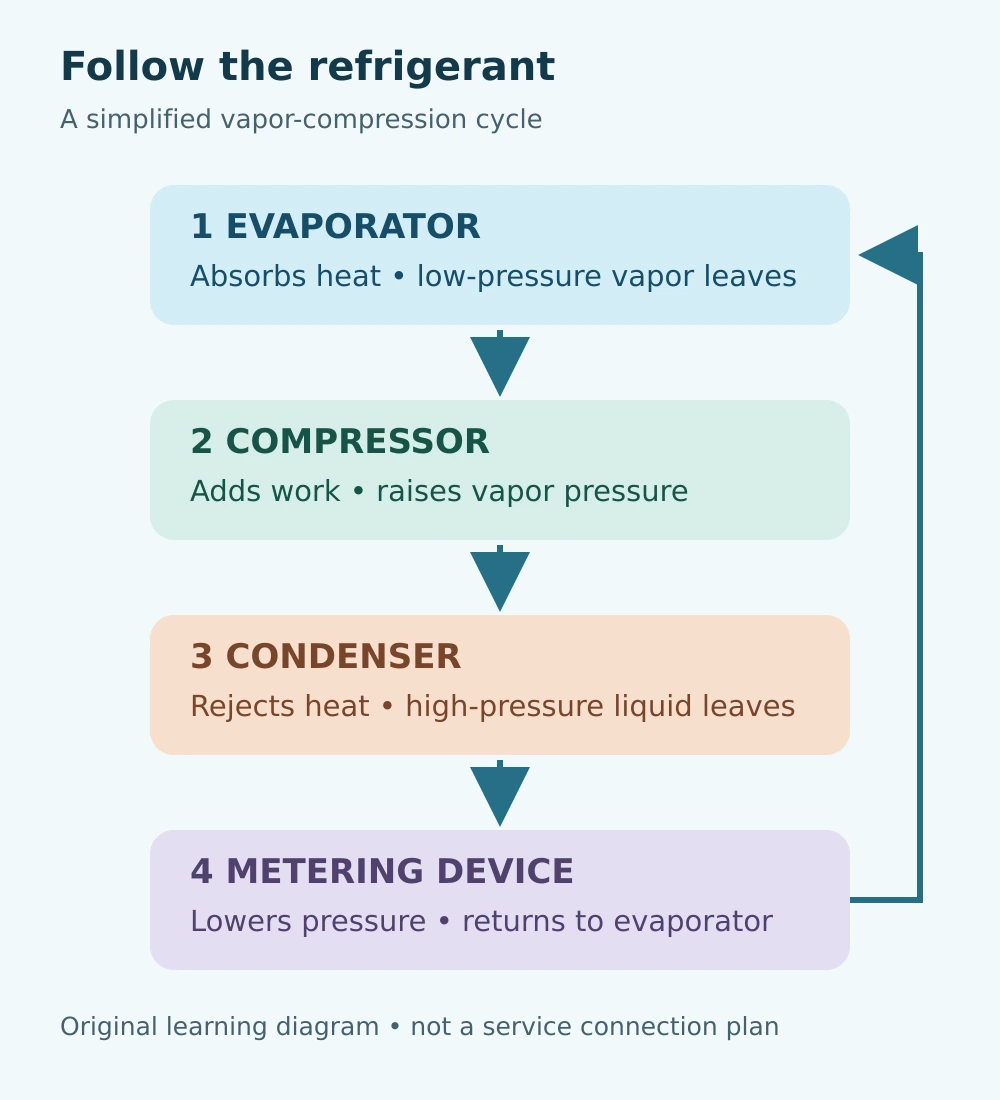
The drawing is a learning schematic, not a service connection diagram. It omits controls, valves, receivers and safety devices that depend on the appliance.
Recover means remove refrigerant and store it externally without necessarily cleaning or testing it. Recycle means clean it for reuse by the same owner without meeting every reclamation requirement, typically with oil separation and filtration. Reclaim means reprocess and verify it against the applicable Appendix A specifications based on AHRI 700-2016. A clean-looking cylinder or one pass through a filter does not prove reclamation purity. The exact definitions and same-owner distinction appear in §82.152; permitted return of recovered refrigerant is addressed in §82.156(h).
Identify refrigerant from reliable current labels, records and appropriate verification, especially after a retrofit. Keep different refrigerants separate. Residual material in hoses and the recovery machine can contaminate the next batch; clear it into the appropriate container using the manufacturer’s procedure. A recovery machine’s purge function is not permission to discharge refrigerant outdoors. YELLOW JACKET’s recovery guidance illustrates why residual charge and inlet contamination matter.
4. Pressure, temperature, blends and oils
A pressure gauge usually displays pressure relative to the surrounding atmosphere. Absolute pressure includes that atmosphere: psia = psig + local atmospheric pressure. The familiar 14.7 psi is an approximate standard sea-level value, not a universal value at every altitude. Vacuum inches also have a reference: 28 inches Hg vacuum is not 28 inches Hg absolute. A deep-vacuum micron gauge is needed to resolve the small absolute pressures used for dehydration.
For a pure refrigerant with liquid and vapor in equilibrium, temperature determines saturation pressure. A vapor-only charge can be superheated and does not have to match the saturation value. A stabilized two-phase container above the expected P/T value can suggest noncondensables or wrong contents, but P/T alone does not certify chemical identity. A zeotropic blend has different liquid and vapor saturation values: use the dew point for suction superheat and bubble point for liquid subcooling. Read the units, phase column and refrigerant name before using a chart. The Chemours replacement-refrigerant guide labels those distinctions; use the exact current refrigerant data for field work. Technical references: Parker/Sporlan Form 10-135, pages 2–3.
Worked example: three different calculations. A gauge reads 74.6 psig where atmosphere is 14.7 psi: absolute pressure is 89.3 psia. Separately, a supplied dew-point saturation temperature is 39°F and measured suction-line temperature is 53°F: superheat is 14°F. For a liquid line at 87°F with a supplied bubble point of 99°F, subcooling is 12°F. The latter two are temperature differences, not pressures; using the dew point for that subcooling example would answer a different question.
Alternative refrigerants are not automatically interchangeable. Lubricant solubility, viscosity, materials, pressures, capacity and equipment approval can change. POE is common in stationary R-134a equipment, while other applications use other approved oils; “use any ester” is not a specification. Blend fractionation can change composition when components separate or escape at different rates, so follow the prescribed charging method. A lower-GWP hydrocarbon is not automatically an approved retrofit into equipment built for a nonflammable refrigerant. EPA’s substitute-refrigerant objectives and the Carrier T-372 service instructions show why model and refrigerant instructions matter. Technical references: Copeland 93-11, R-134a approval rows.
5. Recovery, dehydration and safety are separate checks
Recovery retains refrigerant. Dehydration evacuation removes air and moisture after refrigerant has been recovered and the necessary work completed. A vacuum pump exhausting refrigerant is not a substitute for a recovery machine. A momentary low reading at the pump does not prove the appliance is dry or leak-free: measure at the system, isolate as required, and interpret pressure rise with the equipment procedure. Recovered liquid, oil holding dissolved refrigerant, moisture and leaks can each affect later readings in different circumstances. The manufacturer’s vacuum guidance explains the difference between a coarse manifold reading and a system micron measurement.
Recovery speed depends on the appliance, refrigerant phase, temperature, equipment capacity and restrictions. Accessible liquid transfer often moves the bulk mass faster than vapor-only recovery. Shorter, larger-bore compatible hoses reduce resistance. Approved cooling of the receiving cylinder can reduce backpressure; approved warming of the source can help release refrigerant. None of these principles authorizes uncontrolled heating, defeated cutouts, excess cylinder fill or an incompatible recovery machine. After reaching an endpoint, a pause can reveal pressure rebound from remaining refrigerant; do not confuse the first low reading with verified completion.
Use a suitable approved refillable recovery cylinder, within its service and inspection limits. Never refill a disposable virgin-refrigerant cylinder. The commonly taught 80% maximum liquid-fill principle leaves expansion room, but actual filling limits must match the cylinder, refrigerant and transport requirements. Monitor mass with the proper scale; paint color is not a content label or proof of pressure rating. Correct refrigerant identification and required shipping marks/labels remain essential. These issues form the Core safety and shipping objectives.
Liquid refrigerant can injure eyes and skin through rapid cooling. Vapor can displace oxygen, and refrigerant-specific toxic or cardiac effects may matter. Suitable gloves and eye protection address splashes; a particulate mask does not supply oxygen. Leave a major release area and use the site emergency response rather than entering on the assumption that “nonflammable” means safe. Flames and hot surfaces can form hazardous decomposition products. For permitted pressure testing, dry nitrogen needs appropriate regulation and relief protection; oxygen and oxygen-containing compressed air are unsuitable substitutes. Actual pressure limits come from the appliance and service equipment. Carrier’s service warnings provide a concrete manufacturer example.
6. Type I: small appliances
A small appliance is factory-manufactured, charged and hermetically sealed, with 5 lb or less of refrigerant. All conditions matter. A field-assembled split system with a 4-lb charge is not a small appliance merely because the charge is small. See the regulatory definition.
The percentage recovery route depends on the recovery equipment’s manufacture date, not the appliance’s age. With equipment manufactured before November 15, 1993, recover 80%. With equipment manufactured on or after that date, recover 90% if the appliance compressor functions or 80% if it does not. The separate alternative is evacuation to 4 inches Hg vacuum. These are alternatives in §82.156(b); do not combine the percentages into a new invented threshold.
Worked example. A small appliance initially contains 4.0 lb and its compressor functions. With modern equipment under the percentage route, the minimum recovered mass is 4.0 × 0.90 = 3.6 lb. If the compressor does not function, that percentage route becomes 4.0 × 0.80 = 3.2 lb. The full set of conditions must be known before choosing the percentage; appliance age does not select the equipment-date rule.
System-dependent or passive recovery relies on appliance components; self-contained equipment does not. A functioning compressor can provide the driving pressure in a suitable passive procedure. If it has failed, restrictions such as a capillary tube may leave refrigerant on both sides, requiring appropriate dual access. Manufacturer-permitted warming or agitation can help release refrigerant held in compressor oil. Use only the approved collection method; an arbitrary bag or a vacuum pump exhausting into the room is not equivalent. Temporary piercing fittings should be removed and the circuit properly resealed and checked after service. These techniques are listed in EPA’s Type I objectives, with equipment instructions controlling actual execution.
7. Type II: selecting the correct evacuation row
Current pressure classes use liquid-phase saturation pressure at 104°F: low below 45 psia, medium from 45 to 170 psia, high from 170 to 355 psia, and very high above 355 psia or a critical temperature below 104°F. The regulation lists R-134a as medium, R-22 as high and R-123 as low. Read the current §82.152 definitions rather than importing a historic “high-pressure” label into today’s table.
For ordinary major service or disposal, Table 1 of §82.156 uses the following endpoints. Values in inches are inches Hg vacuum relative to standard atmospheric pressure of 29.9 inches Hg. “Older” means recovery/recycling equipment manufactured or imported before November 15, 1993; “modern” means on or after that date.
- Very high pressure: 0 inches with either equipment date.
- High pressure, below 200 lb: 0 inches with either date.
- High pressure, 200 lb or more: 4 inches older; 10 inches modern.
- Medium pressure, below 200 lb: 4 inches older; 10 inches modern.
- Medium pressure, 200 lb or more: 4 inches older; 15 inches modern.
- Low pressure: 25 mm Hg absolute with either date, without the 200-lb split.
Worked example. A leak-free R-134a appliance has a full charge of 220 lb, needs an evaporator replacement and uses modern recovery equipment. First, R-134a is medium pressure. Second, 220 lb is in the 200-or-more row. Third, evaporator removal is major maintenance. The ordinary endpoint is therefore 15 inches Hg vacuum. Selecting zero merely because an old guide calls R-134a “high pressure” would be wrong.
Major maintenance includes removing a compressor, condenser, evaporator or auxiliary heat-exchange coil, and also exposing more than 4 square inches of flow area for more than 15 minutes. A qualifying non-major exception, where evacuation to the atmosphere will not follow completion, permits no higher than 0 psig for medium/high/very-high appliances. Oil changes have a specific no-higher-than-5-psig provision. Leaks preventing the ordinary endpoint do not excuse all recovery: isolate sound parts where possible, apply their normal endpoint, and recover leaking parts to the lowest attainable level without substantial contamination, never above 0 psig. Portable system-dependent equipment cannot be used above 15 lb full charge unless the stated permanent pump-out exception applies. Sources: definitions and evacuation rules.
8. Leak diagnosis and two current regulatory regimes
An oil trace or excessive superheat can suggest leakage, but neither identifies the complete cause. A standing pressure test may show a loss without locating it. Use an appropriate locating method such as an electronic detector, bubbles or another suitable technique. The regulatory definition of leak inspection distinguishes these functions. Refrigerant is circulated rather than normally consumed; repeated unexplained top-ups are not a diagnosis.
ODS under §82.157. Since April 10, 2020, this section’s leak-repair scope is appliances with a full charge of at least 50 lb of class I/II refrigerant or a blend containing it. Solely substitute refrigerants are outside this section. The current annual leak-rate triggers are 20% for commercial refrigeration, 30% for industrial process refrigeration, and 10% for comfort cooling/other covered appliances. A supermarket food system is commercial refrigeration; an office chiller is comfort cooling. These are action triggers, not permission to deliberately vent below them. See §82.157.
HFCs and specified substitutes under §84.106. Separate AIM requirements apply from January 1, 2026, starting at a 15-lb full charge for covered refrigerants. They include regulated substances and specified substitutes with GWP greater than 53. Appliances containing solely ODS and the residential/light-commercial AC and heat-pump subsector are excluded from this section. The 20/30/10% categories remain, with the 10% category also addressing other covered appliances including refrigerated transport. A proposed exemption is not an enacted exemption. “HFC leak repair was removed from Section 608 in 2020” is therefore not a complete statement of November 2026 obligations. Read the current Part 84 text.
Worked example: scope before arithmetic. A 40-lb HFC supermarket refrigerator may be outside the ODS-only §82.157 yet inside §84.106. Do not stop at “below 50 lb.” For an established annualizing calculation with 4 lb added to a 40-lb full charge after 182.5 days, the rate is (4/40) × (365/182.5) × 100 = 20%. That equals, rather than exceeds, a 20% trigger. Different facts or later additions can change the result. Part 84 also specifies special initialization for the first calculation after January 1, 2026; do not apply this example’s established interval to that first calculation. Sources: annualizing and rolling-average definitions; Part 84 calculation provisions.
The annualizing method scales a recent addition to a year using the shorter of elapsed days and 365. The rolling-average method divides relevant additions over its defined period by full charge and multiplies by 100; it does not use that same elapsed-days multiplier. Keep the chosen method and its allowed changes consistent with the applicable rule.
9. Repair, verification, inspections and records
For covered exceedances, the ordinary repair period is 30 days, or 120 days if an industrial process shutdown is required. Specific extensions have conditions, documentation and deadlines; parts delay is not an automatic suspension of every duty. Complete feasible repairs while addressing qualifying delayed components. Mothballing has its own defined effect on deadlines. Both §82.157(d)–(f) and §84.106(d)–(f) should be consulted for the actual case.
Initial verification checks the repair before additional refrigerant is added. Follow-up verification normally occurs within 10 days of successful initial verification, or within 10 days of return to normal conditions when evacuation was needed. A pressure test before repair is not proof that the repair succeeded, and an invoice saying “fixed” is not a recorded verification result. Special unsafe/impossible circumstances are addressed in the rule rather than by inventing a new general deadline.
Covered commercial/IPR appliances at 500 lb or more ordinarily require quarterly leak inspections after an exceedance until the specified four-quarter compliance demonstration. Smaller covered commercial/IPR appliances use annual inspection; comfort-cooling/other categories have their own annual provision. Under Part 84, the smaller range begins at 15 lb and the schedule runs after successful follow-up verification; under §82.157 the relevant range starts at 50 lb and uses its stated calendar-year language. A qualifying continuously monitored portion may receive an inspection exception, but an unmonitored portion remains subject to applicable inspections. The monitoring system must meet the relevant conditions, including audit/calibration requirements. Sources: §82.157(g); §84.106(g).
Loss of at least 125% of full charge in a calendar year triggers chronic-leak reporting for appliances within the applicable scope, due March 1 of the following year. Loss can exceed one full charge because replacement refrigerant leaks again. An ordinary retrofit/retirement plan is created within 30 days of the relevant trigger and completed within one year of its date, unless a specified extension applies. Service and verification records need appliance identity, dates, relevant quantities, work, locations, methods and results. Many records have a minimum three-year retention period; full-charge records have the specific requirement through three years after retirement. Sources: §82.157(h)–(m); §84.106(h)–(m).
10. Type III: low-pressure chillers
A low-pressure chiller can operate below atmospheric pressure, so leaks can draw air and moisture inward. Increased purge activity can therefore indicate a leak even when there is no obvious outward refrigerant spray. The purge removes noncondensables; it is not the main recovery machine. At other temperatures or conditions the same appliance can leak outward, so “low pressure” is not a universal statement about leak direction. These relationships are central to EPA’s Type III objectives.
Controlled hot-water or built-in heating/pressurization methods can raise pressure without adding noncondensables. Actual leak-test pressure and recovery-unit cutout values are model-specific: a relief setting is a protection limit, not a target, and a factory proof-test value is not automatically a permitted field-test pressure. The bank supplies model limits in its illustrative question rather than presenting one pressure as universal. For the particular non-major repair exception in §82.156, refrigerants boiling at or below 85°F at standard atmosphere must not be pressurized by methods such as nitrogen that require subsequent purging. Above 85°F, heat is used first and nitrogen may then bring the remainder to atmospheric pressure. That narrow exception must not be confused with all leak-testing situations. See §82.156(a)(1)(ii).
Transfer of bulk liquid leaves vapor and refrigerant dissolved in oil. Controlled oil warming can help separate the latter into recovery; EPA’s outline mentions 130°F, but the actual model procedure and limits govern execution. During evacuation, evaporating refrigerant can cool water-filled tubes enough to freeze them, so maintain specified water circulation or drain as the manufacturer directs. Recharging may require vapor first to raise pressure before admitting liquid, avoiding rapid flashing and freezing. Use the specified evaporator charging connection and the refrigerant-specific procedure, not a matching oil port or purge outlet. Source: Type III recovery and recharging topics.
Worked example: vacuum units. Twenty-five mm Hg absolute equals 25,000 microns Hg absolute. It is the ordinary low-pressure recovery endpoint, not a 500-micron dehydration target. If local atmosphere is 29.9 inches Hg and a gauge indicates 28.7 inches Hg vacuum, the absolute pressure is 1.2 inches Hg. Do not compare a gauge-vacuum number with an absolute number without converting the reference and units.
Machinery-room protection must account for the actual refrigerant, applicable standard and adopted code. An oxygen monitor does not measure every refrigerant-specific exposure hazard. R-123 needs an appropriate refrigerant detection/ventilation strategy; no universal alarm setpoint is supplied here. As a concrete official design example, the Ohio Facilities Construction Commission’s 2024 monitoring specification explicitly distinguishes oxygen-deprivation monitoring from refrigerant exposure monitoring. It is an Ohio design specification, not a substitute for the standard adopted at every U.S. site.
11. Prepare by explaining decisions
Start with the cycle, the three Rs and pressure references. Then classify appliances and work through the recovery table until you can explain why each row applies. Study Type I passive recovery separately from Type II systems and Type III vacuum behavior. Next build a scope decision for leak rules: refrigerant, charge, application, applicable section, calculated rate, action and documentation. Finish with safety and equipment-specific limitations. This order is an editorial study recommendation, not an EPA-mandated timetable.
Use the 126-question EPA 608 Universal learning bank to test those explanations. It includes 116 single-choice questions and 10 numerical-entry calculations, presents the whole bank in shuffled order, and has no timer or pass threshold. Numbers should be entered without units or thousands separators; decimal point or comma is accepted. Read every explanation, including why the other options fail. The bank is broader than a single official test and does not reproduce its exact timing or selection.
For a missed question, record the reason: wrong pressure class, wrong date, wrong units, wrong legal scope, wrong phase reference or unsupported practical assumption. Re-read the relevant source and solve another case before treating the topic as understood. Arrange the approved examination only after checking its provider-specific booking and test arrangements; arrange supervised practical training independently of this website.
12. Sources and further reading
- U.S. EPA, Test Topics, page updated November 24, 2026: complete public Core/I/II/III outline. Some historical wording requires comparison with current regulations.
- U.S. EPA, Section 608 Technician Certification Requirements: credential and testing overview.
- 40 CFR 82.152, 82.154, 82.156, 82.157, 82.161 and Appendix D: definitions, venting/sales, recovery, ODS leaks, certification and test rules; eCFR current through November 25, 2026 when checked.
- 40 CFR 84.106: current HFC/substitute leak-repair requirements. Read scope and exceptions before using the thresholds.
- 40 CFR 19.4: operative civil penalty adjustment table, checked November 28, 2026.
- U.S. EPA, Basic Ozone Layer Science, and the linked Class I/Class II phaseout pages: environmental mechanisms and production/import history.
- YELLOW JACKET, Technical Questions; Carrier, T-372 PrimeLINE, Section 7; Chemours pressure-temperature guide: manufacturer examples, not interchangeable instructions for every appliance.
- Ohio Facilities Construction Commission, Refrigerant Monitoring Systems, 2024: example of distinguishing refrigerant monitoring from oxygen monitoring.
All sources were checked for this educational package on November 28, 2026. Diagrams and examples are original. No closed EPA question pool, paid ESCO manual or third-party chart artwork is reproduced. The public sources support theory preparation; they do not replace the actual appliance instructions or the current rules applicable to a real job.